Create a YouTube Short in 2026 by choosing one viewer promise, writing a hook for the first screen, filming or assembling a vertical video, editing every beat around that promise, uploading the finished file in YouTube or YouTube Studio, and publishing after a rights and metadata check. A first Short commonly takes 30–60 minutes before research, filming, or detailed editing.
Key takeaways:
- YouTube Shorts can be up to 3 minutes long for videos uploaded on or after October 15, 2024, according to YouTube Help.
- Since March 31, 2025, a YouTube Shorts view counts whenever a Short starts or replays, with no minimum watch-time threshold, according to YouTube’s announcement.
- YouTube Shorts reached 70 billion daily views by 2024 and had more than 2 billion monthly users by early 2026, according to Retensis.
- Creators who monetize Shorts through the YouTube Partner Program receive 45% of their allocated Shorts ad-revenue share after accepting the relevant terms, according to YouTube Help.
Prerequisites: You need a YouTube channel, a defined viewer, a topic that can be shown or explained visually, and rights to every clip, image, sound, voice, and brand asset you use. Start with one repeatable subject area rather than posting unrelated ideas. A channel about beginner cooking, for example, can cover ingredient substitutions, knife mistakes, and quick techniques; a channel that alternates between cooking, celebrity news, and software tutorials gives viewers little reason to expect another relevant Short.
What are the latest rules for posting YouTube Shorts in 2026?
YouTube Shorts in 2026 are vertical short-form videos that creators can record in the YouTube app or upload as completed edited files. Eligible uploads made on or after October 15, 2024 can run up to 3 minutes. Before publishing, creators should confirm that every visual, voice recording, clip, and music track is cleared for use, because a compelling edit cannot overcome a copyright restriction or monetization-policy problem. YouTube’s Shorts upload guidance remains the source of record for current Shorts length and music rules.
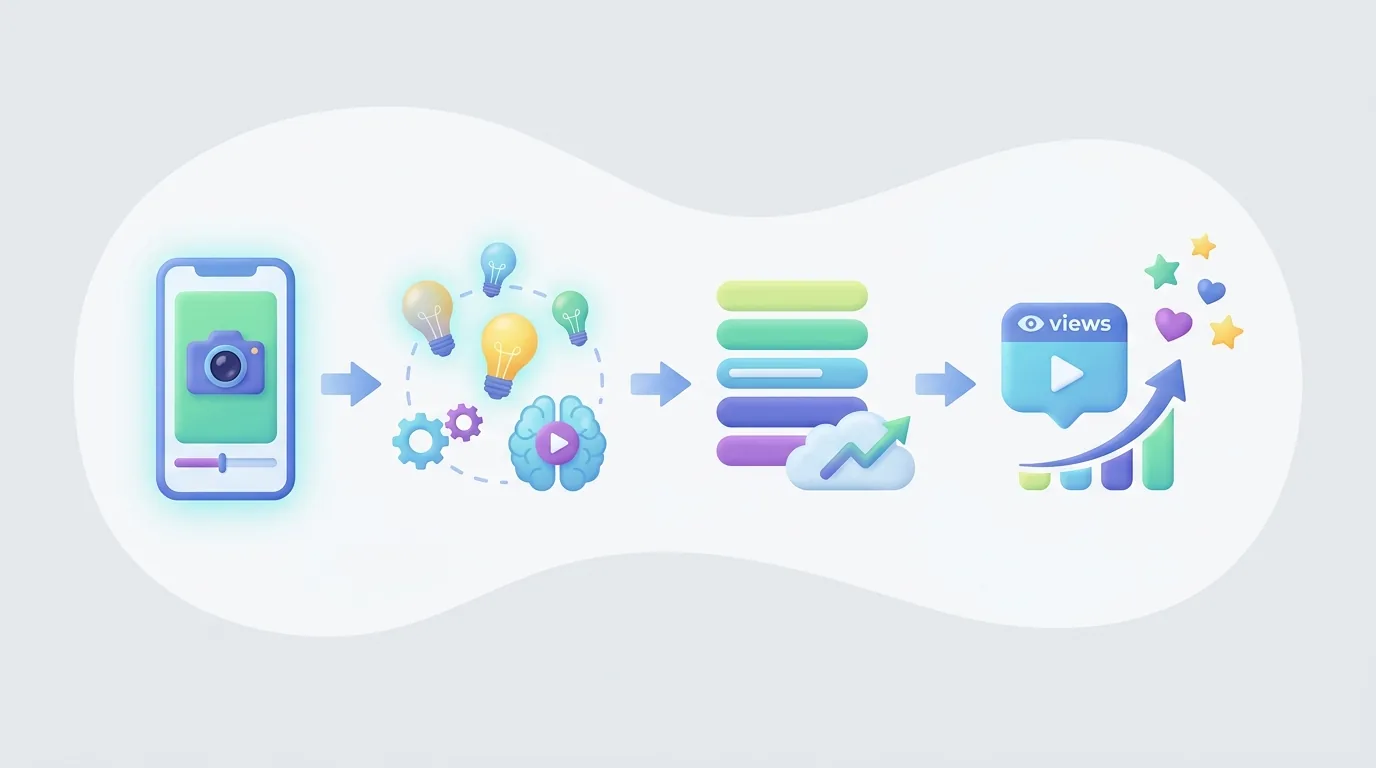
The practical workflow is simple, but each stage solves a different problem:
- Choose one viewer outcome before writing. A YouTube Short needs a specific promise a viewer can understand immediately: “three desk stretches for stiff shoulders,” “the sales phrase that hides a price increase,” or “the one setting that fixes this editing mistake.” Write the outcome in one sentence. If the outcome contains two unrelated benefits, split it into two Shorts.
- Write the first spoken line and first visual together. A hook is not only narration. The viewer should see the subject, result, mistake, or contrast while hearing the opening line. For a cooking Short, show the finished dish or the failed result first. For a software tip, show the setting or error message first. The first screen should still communicate the premise when watched without sound.
- Build a vertical sequence around a single question. Arrange the Short as a progression: hook, context, proof or steps, and payoff. Each scene should either answer the viewer’s question, prove the answer, or move the explanation forward. Remove greetings, logo animations, repeated setup, and side points that delay the promised result.
- Edit for continued attention, not just speed. Cut pauses before the next useful word, trim a shot once it has made its point, and change the visual when the explanation changes. A visual change can be a new angle, screen recording, close-up, text card, example, or before-and-after comparison. Fast cutting is not automatically better; the viewer still needs enough time to read captions and understand evidence.
- Check rights and policy fit before upload. Confirm the origin or license of every reused clip, image, song, sound effect, and logo. Verify that the narration is genuinely written for the video rather than copied from a generic template. Longer Shorts require particular care with music restrictions, so review YouTube’s current guidance before relying on a track.
- Upload with metadata that matches the video. Upload through YouTube or YouTube Studio, then use a precise title and description. A title such as “Fix harsh caption timing in three edits” tells a viewer more than “Editing hack.” Metadata should describe the actual payoff; it should not promise a result the Short never demonstrates.
- Review the response and change one decision next time. After the Short has had time to circulate, note where attention appears to fall, what comments reveal, and whether viewers ask a natural follow-up question. Keep the audience and topic stable for several posts. Then test one variable—opening line, proof shot, pacing, structure, or ending—rather than changing everything at once.
A practical first-Short production checklist
A beginner can complete a useful Short without a complicated production setup. Draft a 60- to 90-word narration, list the visuals required for each sentence, record or collect only cleared assets, and build the edit in the same order a viewer will experience it. Add captions after the voiceover or final script is set, not before; otherwise, every wording change creates avoidable caption work.
Before publishing, watch the export in three ways. First, watch with sound off to see whether the images and captions carry the premise. Second, listen without watching closely to check whether the explanation makes sense as audio. Third, watch normally and ask one direct question: does the ending deliver the result promised in the opening? If the answer is unclear, revise the script or sequence before adding decorative effects.
How long can my YouTube Shorts be?
YouTube Shorts can be up to 3 minutes long for eligible uploads made on or after October 15, 2024. The expanded maximum gives creators room for a compact tutorial, story, comparison, or explanation, but three minutes is a ceiling, not a target. YouTube Help’s Shorts update confirms the expanded maximum and explains that music rules can differ for Shorts longer than 1 minute.
Choose runtime according to the amount of proof the promise requires. A visual before-and-after may need only a setup and reveal. A practical lesson may need a hook, two or three steps, and a recap. A short story may need a situation, a turning point, and a clear ending. A comparison may need to show both options under the same condition before making a recommendation. The Short should end when the viewer has received the promised value, not when an arbitrary duration has been reached.
Use a structure that fits the idea
A very short demonstration can use this sequence:
- Opening: “This is why your captions feel late.”
- Proof: Show a caption appearing noticeably after the spoken word.
- Fix: Show the caption moved to the beginning of the phrase.
- Payoff: Show the corrected version and state the editing rule.
A more detailed tutorial can use a different sequence:
- Opening: “Use these three checks before publishing a client proposal.”
- Context: Name the risk: unclear scope, missing approval, or an unsupported claim.
- Steps: Show one document section or example for each check.
- Payoff: End with a usable checklist rather than a vague reminder to “be professional.”
The second format needs more time because it contains more decisions and more evidence. The first format should remain brief because extending it would repeat a point the viewer already understands.
Longer Shorts need stronger pacing discipline. Change the visual when the explanation changes, show the proof behind the claim, and use captions that clarify rather than mechanically duplicate every spoken word. If narration says “compare the two exports,” the screen should show the two exports. If narration says “this clause changes the price,” the screen should highlight the clause. The relationship between narration and picture should be obvious.
Before uploading, watch the video once without sound and once at normal speed. If the point is unclear without audio, add clearer captions or visual proof. If the ending adds no new value, remove it rather than filling the time. If a viewer needs background information to understand the opening, rewrite the hook so the Short can stand on its own in the feed.
What changes were made to view counting on YouTube Shorts?
YouTube changed Shorts view counting on March 31, 2025: a view now registers whenever a Short starts to play or replays, with no minimum watch-time requirement. YouTube’s official announcement states, “Views are counted when a Short starts to play or replay,” in its YouTube Help update. Public Short view totals therefore represent starts and replays under the updated system, rather than a measure that requires a minimum watch duration.
The updated view count is useful, but it should not become the only verdict on a creative decision. A start indicates that the Short was served and playback began. It does not, by itself, prove that viewers understood the opening, stayed for the payoff, trusted the creator, subscribed, or took a meaningful next action. Use the view total as one distribution signal, then examine the audience-response and retention information available in YouTube Analytics.
A creator testing hooks should interpret the data in context. Suppose two Shorts explain the same skill to the same audience. The first opens with “Today I’m going to show you a useful trick.” The second opens with “Your export looks blurry because of this setting.” If the second version receives stronger continued attention, the useful lesson is not merely that it received views; it is that the opening named a recognizable problem and gave viewers a reason to wait for the solution.
For a clean experiment, publish several Shorts for the same intended viewer and compare them after they have had similar time to circulate. Keep the topic and payoff broadly consistent, then change only one element:
- the first spoken line;
- the opening visual;
- the order of a demonstration;
- the number of steps;
- the speed of a section that loses attention; or
- the final prompt for another video or comment.
This approach turns the updated count into part of a useful production review. Instead of asking, “Did this Short go viral?” ask, “Which opening, proof, and ending helped this audience understand and continue watching this specific type of video?”

How do image posts affect my channel's view count?
Image posts and YouTube Shorts should be evaluated as separate formats unless YouTube’s current reporting documentation and your own YouTube Studio analytics explicitly show how each format is included in a particular channel-level metric. The cited Shorts getting-started documentation should not be treated as evidence for a broad April 2026 claim that image posts changed a channel’s public view count. Creators should verify current format definitions in YouTube Studio rather than base reporting decisions on an unsupported interpretation.
The practical reporting principle is straightforward: do not use a single lifetime channel total to judge whether a Short concept is working. An individual Short answers questions about one video’s distribution and audience response. A channel-level figure can reflect many publishing decisions over time and may not isolate the format, topic, audience, or period you are trying to evaluate. Comparing unlike formats without labels can make a useful editorial decision look like a misleading performance trend.
Use a simple planning sheet to preserve meaningful comparisons. For every published item, record the format, topic, publish date, intended viewer, opening promise, primary call to action, and the question you wanted to test. Add a note after publication describing the comments, retention pattern, or follow-up topics it generated. This is useful whether you publish Shorts alone or mix video with other community formats.
Image-based posts can still support a Shorts strategy when they serve the same audience need. A creator who publishes quick cooking Shorts could use an image post to ask which ingredient substitution viewers struggle with, preview a checklist, or collect questions for the next demonstration. The image post has an editorial job: reveal a topic, gather language from viewers, or support a series. It should not be used to make an unsupported claim about Shorts performance or to inflate an internal report.
When reviewing results, compare like with like. Compare a cooking Short about knife safety with other cooking Shorts aimed at beginners. Compare a community image post with other community image posts designed to collect responses. Then connect the two formats qualitatively: did the questions on the image post produce a clearer Short topic, and did the resulting Short answer those questions well? That is a more defensible workflow than assuming every channel-level count represents the same type of viewing behavior.
What is considered inauthentic content for Shorts monetization?
Inauthentic content for Shorts monetization is content that is mass-produced or repetitive rather than meaningfully original and valuable to viewers. YouTube’s monetization policy says, “Inauthentic content is content that is mass-produced or repetitive,” in the YouTube Partner Program policy. A faceless format is not inherently inauthentic. The central question is whether the channel repeatedly publishes low-variation material without original commentary, narrative, analysis, reporting, demonstration, or educational value.
Originality is visible in the editorial decisions behind the Short. A creator can make an original Short without appearing on camera by researching a narrow question, writing a specific explanation, selecting visuals that prove the explanation, and arriving at a conclusion that belongs to that video. By contrast, changing only a name, image, or background clip in a repeated template does not automatically create a distinct viewer experience.
Consider the difference between these two approaches:
- A generic template says, “Here are three habits of successful people,” over unrelated stock footage. The ideas may be broad, the evidence unclear, and the same structure easily reused with minimal changes.
- An editorial Short says, “This proposal sentence creates scope confusion,” shows the sentence, explains the practical consequence, and demonstrates a clearer rewrite. The value comes from a specific example and interpretation.
The second approach gives the viewer a reason to watch that particular Short. It also creates a record of the creator’s contribution: the research choice, explanation, example, script, and edit all work together.
Run a pre-publish originality check before releasing a series. Ask: Can I explain what a viewer learns, understands, or feels here that they would not get from a generic compilation? Is the narration specific to this video? Do the visuals prove, illustrate, or advance the point? Are captions accurate? Would the conclusion still make sense if the stock footage were removed? Keep source notes and rights records for material you did not create. These habits improve the work itself and make monetization review less risky.
What are the requirements to join the YouTube Partner Program for Shorts?
To monetize YouTube Shorts, a creator must join the YouTube Partner Program and accept the relevant monetization terms; eligible creators keep 45% of their allocated Shorts ad-revenue share. YouTube Help lists the current Partner Program eligibility paths and explains that meeting an entry threshold is not the same as automatically earning Shorts Feed ad revenue. Channels must also comply with YouTube monetization policies and any applicable eligibility requirements shown in YouTube Studio.
YouTube provides an earlier-access route for qualifying creators in eligible countries: 500 subscribers, 3 valid public uploads in the previous 90 days, plus either 3,000 valid public watch hours in the previous 12 months or 3 million valid public Shorts views in the previous 90 days. For full ad-revenue sharing, YouTube lists 1,000 subscribers plus either 4,000 valid public watch hours in 12 months or 10 million valid public Shorts views in 90 days. Review the live eligibility panel in YouTube Studio before planning around a threshold, because creators should make decisions from the current product information available to their channel.
The two routes serve different publishing realities. A channel focused primarily on Shorts may pay close attention to valid public Shorts views in the stated 90-day window. A channel that combines Shorts with longer educational videos may have a different mix of watch hours, subscribers, and discovery paths. Neither route removes the need for original content, cleared rights, accurate information, and compliance with YouTube’s monetization policies.
Treat monetization as a result of a reliable viewer promise rather than as the first creative brief. Build a series with a stable topic, retain rights to the material, and publish work you can explain and defend as original. A consistent niche gives viewers a reason to subscribe, and subscriber growth matters because it is part of the full ad-revenue threshold.
A practical planning approach is to make a content map before chasing a number. Choose three recurring audience questions, create several distinct Short ideas under each question, and identify what evidence each video needs. For example, a beginner editing channel might create separate Shorts on cutting pauses, caption timing, export settings, and organizing footage. The creator can then review which problem produces useful comments and returning interest instead of repeatedly remaking the same generic editing tip.

How can I monetize my YouTube Shorts effectively?
Effective YouTube Shorts monetization starts with eligible, original content and a channel strategy that can meet YouTube Partner Program requirements. Shorts Feed ad revenue is one income path, but creators can also use Shorts to lead qualified viewers toward products, services, long-form videos, or other offers they can legitimately promote. The foundation remains policy compliance: creators must be in the YouTube Partner Program, accept the relevant terms, and follow YouTube monetization policies.
Choose a monetization path that matches the viewer’s reason for watching. An education channel can publish a concise lesson that naturally leads to a fuller guide or related long-form video. A business-focused channel can answer a narrow buyer question and invite viewers to a relevant next step. A product-focused channel can demonstrate a real use case, limitation, or comparison. The Short should deliver its promised insight before it asks for anything from the viewer.
A useful monetization structure is:
- Solve one small problem in the Short. Give the viewer a complete, honest answer at the scale promised by the hook.
- Name the logical next step. The next action should continue the same task: another lesson, a fuller demonstration, a relevant service, or a product the viewer can reasonably evaluate.
- Use one direct call to action. Multiple unrelated prompts compete with the lesson and can make a Short feel like an advertisement rather than useful content.
- Keep records of what was promised. If a Short promotes an offer, ensure that its wording, visuals, and claim accurately reflect the offer.
For example, a creator explaining how to organize raw footage can make the Short about one concrete folder structure. The relevant next step could be a longer video that demonstrates the full editing workflow. An unrelated promotional message would weaken the viewer journey because it does not follow from the problem just solved.
Build a content library, not isolated viral attempts. Group Shorts into recurring themes so a viewer who likes one can find another with the same benefit. Keep an editorial calendar that tracks the topic, viewer problem, opening line, evidence used, production status, and next action. If a creator uses an AI-assisted production workflow, editorial review remains essential: verify the research, correct the script, confirm rights, and ensure that the final video has a distinct point of view.
What strategies can increase visibility for my YouTube Shorts?
YouTube Shorts visibility improves when a Short gives a defined audience an immediate reason to keep watching and a clear reason to view another video from the same channel. The opportunity is substantial: YouTube Shorts reached 70 billion daily views by 2024 and surpassed 2 billion monthly users by early 2026, according to Retensis research. Reach is not guaranteed, so creators should make relevance, evidence, and clarity visible from the opening screen.
Use these practical visibility strategies:
- Open with the outcome or tension. State what the viewer will gain, see, avoid, or decide. Replace “Here’s a tip for creators” with “Your first line loses viewers when it starts with background.” The second line names a problem and creates a reason to keep watching.
- Match the title, opening, and payoff. If the title promises a comparison, show the comparison immediately and reach a conclusion before the video ends. If the title promises a fix, show the problem and the fix. A mismatch can produce curiosity at the start but disappointment at the payoff.
- Make one series for one audience. Publish related answers to related questions. A creator who explains beginner editing can make separate Shorts on cuts, captions, pacing, screen recordings, and sound. Each Short can stand alone while making the next relevant video easier to discover.
- Design for silent viewing. Use captions, on-screen labels, and visuals that carry the core meaning without requiring audio. Captions should be readable and timed to the idea being explained. Do not place important wording over a busy background if a simple contrasting card or clearer shot would do the job.
- Show proof early. A claim about a design mistake should show the mistake. A claim about a recipe technique should show the texture, timing, or result. A claim about a software setting should show the setting on screen. Proof makes the Short more understandable and reduces the amount of narration needed.
- Use retention editing deliberately. When a new step begins, show a new visual or clear label. When a sentence repeats the preceding point, cut it. When the payoff is ready, reveal it rather than adding a generic closing. Retention editing is not about adding constant motion; it is about removing moments in which the viewer has no new reason to continue.
- Turn comments into follow-up Shorts. A specific audience question is a usable content brief. If several viewers ask how to apply the same technique in a different situation, open the next Short by naming that situation and answering it directly.
- Use topic research before production. Turn broad subjects into narrow, useful angles. “Video editing tips” is broad; “how to cut a pause without making speech sound abrupt” is a specific Short with a clear visual demonstration.
A worked Short script and edit plan
A beginner creator can use this model to turn one narrow question into a publishable Short. The example topic is caption timing:
Viewer question: Why do my captions feel disconnected from the speaker?
Hook and opening visual: “Your captions feel late because they begin after the important word.” Show a short clip in which the caption arrives after the speaker says the key word.
Explanation: “Start the caption at the beginning of the phrase, not after the phrase has already landed.” Show the same clip with the caption timing adjusted.
Proof: Play the late version and corrected version in sequence. Label them clearly so the difference does not depend on narration alone.
Payoff: “The viewer reads the idea as it happens, so the edit feels more connected.” End on the corrected example.
Optional series bridge: “Next: how to shorten captions without changing the meaning.” This works because it names a related problem for the same audience rather than interrupting the lesson with an unrelated promotion.
This script is useful because every line has a production purpose. The hook identifies the pain point. The visual demonstrates it. The explanation gives a rule. The proof validates the rule. The ending completes the promise and provides a natural next subject. Apply the same logic to tutorials, product demonstrations, explainers, stories, and opinion-led Shorts.
Review performance in batches rather than reacting emotionally to one upload. Keep the topics and openings that produce clear audience response, then improve the next Short with a stronger proof point, simpler wording, better caption timing, or a more focused question. A repeatable workflow creates more useful learning than constantly changing niche, style, and audience.
Make your next Short: Build one useful vertical video around one audience question, then create an account if you want an AI-assisted production option.
Sources & further reading
Keep reading

12 Best Niches for Faceless YouTube Channels in 2026
Compare 12 profitable faceless YouTube niches for 2026, including CPM and RPM benchmarks, policy-conscious workflows, and topic examples.

How to Build and Monetise a Faceless YouTube Channel
A complete roadmap for choosing a faceless YouTube niche, building a production system, growing views, and monetising Shorts and long-form content.

How the YouTube Shorts Algorithm Works
Learn how YouTube Shorts recommendations use viewer behavior, format eligibility, retention, AI disclosures, and practical editing tests.