
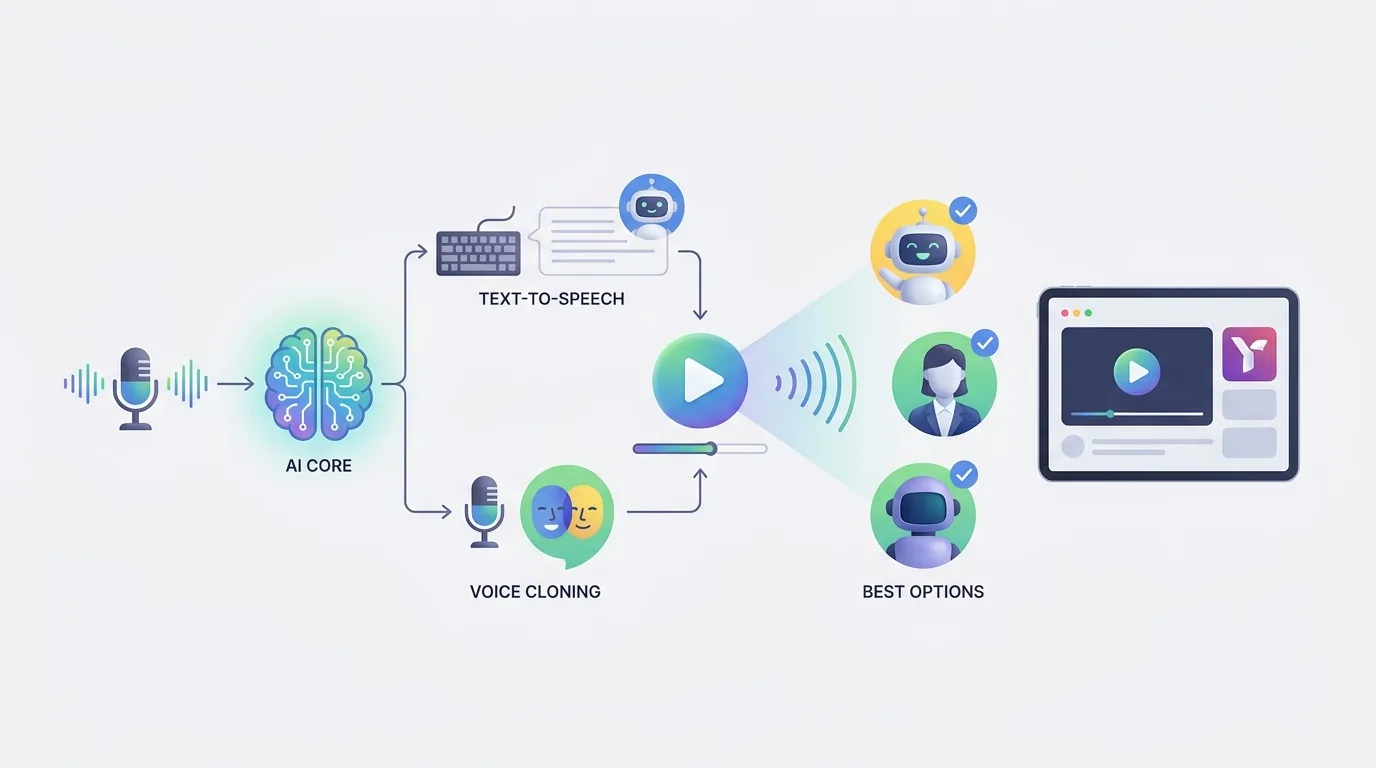
ElevenLabs is the best AI voiceover for YouTube videos when natural-sounding narration, character consistency, or a permission-based cloned voice is central to why viewers watch. OpenAI TTS is the better value when a channel produces a large volume of repeatable narration and needs to control text-generation costs.
Final rule: choose ElevenLabs when the voice is part of the brand and a weak read would damage the video; choose OpenAI TTS when the script, research, editing, and publishing cadence carry more of the value than a distinctive vocal performance.
Key takeaways:
- ElevenLabs is identified as the option with the most natural-sounding AI voices and the strongest voice-cloning capabilities in a YouTube voiceover comparison.
- OpenAI TTS costs about $15 per 1 million characters, according to this cost comparison, which describes it as roughly one-tenth the cost of ElevenLabs at comparable volume.
- The materials cited here do not include a direct ElevenLabs pricing-page citation for a $150-per-million-character rate. Treat that number only as arithmetic implied by the secondary comparison, not as a directly verified ElevenLabs list price.
- YouTube’s altered-content guidance says that a creator using their own AI-generated voice does not need to disclose that use, while significantly altered or realistic synthetic content may require disclosure. See YouTube’s altered-content guidance.
- YouTube’s Impersonation Policy prohibits AI voices that “falsely imply ownership or authorization,” according to YouTube’s official policy.
- The statement that mass-produced or generic AI voiceover videos may fail monetization review is supported here by a vidIQ reused-content policy guide, not by a direct reused-content-policy URL in the supplied source set. Creators should therefore read current YouTube monetization materials before relying on that interpretation.
| Rank | AI voiceover option | Cost benchmark per 1 million characters | Documented strength | Best fit |
|---|---|---|---|---|
| 1 | ElevenLabs | The cited comparison describes OpenAI TTS as about one-tenth the cost; no direct ElevenLabs pricing source is provided here | Most natural voices; strongest voice cloning | Storytelling channels where narration quality is central |
| 2 | OpenAI TTS | Approximately $15, per the cited cost comparison | Approximately 10x lower-cost benchmark than ElevenLabs in that comparison | High-volume explainers, list videos, and repeatable narration |
Which should you choose?
The ElevenLabs-versus-OpenAI TTS decision should be made by identifying what the narration must accomplish in a finished YouTube video. Choose ElevenLabs when the narrator must carry tension, warmth, authority, or a recognizable recurring identity. Choose OpenAI TTS when the channel’s competitive advantage is efficient production of clear, well-researched scripts across many uploads. For either option, test the exact voice against a finished edit, because pacing, pauses, music, captions, and visual cuts can change a promising voice sample into an unsuitable final narration.
A useful budget check is to save five completed scripts, count their characters including punctuation, and estimate one month of output. Then add generation headroom for alternate hooks, pronunciation fixes, revised calls to action, and translated versions. The linked cost comparison provides a practical OpenAI TTS benchmark, but the cited materials do not independently establish ElevenLabs’ current list price. That distinction matters: use the 10x comparison as a directional decision aid, and verify current plan terms directly before purchasing.
What are the top AI voiceover tools for YouTube?
ElevenLabs and OpenAI TTS are the clearest evidence-backed choices in the source material for YouTube narration in 2026, but they win on different criteria. ElevenLabs is the quality-led choice for creators who need natural vocal delivery and voice-cloning capability. OpenAI TTS is the cost-led choice for creators who need repeatable narration at scale. A useful ranking begins with the role the voice plays in the channel, rather than treating every text-to-speech feature as equally important.
ElevenLabs suits videos where the narrator is part of the viewing experience: documentary-style explainers, dramatic stories, recurring characters, and channels with a recognizable vocal identity. Its documented advantages are natural-sounding voices and voice-cloning capability, as noted in this AI voiceover tools comparison. Voice cloning is not merely a convenience feature in this context; it can help a channel maintain a consistent narrator across episodes, provided the person whose voice is involved has clearly authorized that use.
OpenAI TTS suits scripts produced in volume. A creator making short educational videos, news-style summaries, product explainers, or recurring list formats may value a predictable character-based cost more than a highly distinctive narrator. The cited cost comparison places OpenAI TTS at approximately $15 per 1 million characters. Before committing, render the same 150- to 250-word opening in two candidate voices and listen for mispronounced names, awkward sentence stress, rushed list items, and unnatural pauses after captions are added.
The practical ranking can change from one channel to another. A history channel that opens with a dramatic scene may lose more from a flat first 20 seconds than it saves in generation cost. A channel publishing three concise software explainers each week may gain more from a low-cost, consistent generation process than from small gains in vocal expressiveness. The best tool is therefore not the tool with the most impressive standalone demo; it is the tool that preserves quality at the channel’s actual publishing volume.
How does the cost of AI voiceovers compare?
AI voiceover cost compares most usefully at the script level, because a creator purchases spoken text rather than an abstract monthly plan. The supplied cost comparison gives OpenAI TTS as approximately $15 per 1 million characters and characterizes it as about one-tenth the cost of ElevenLabs at the same volume. That makes OpenAI TTS the clear cost benchmark in this comparison, while ElevenLabs is the higher-cost choice associated with documented realism and cloning capability.
The often-repeated approximate figure of $150 per 1 million characters for ElevenLabs is a calculation from the linked secondary comparison: if $15 is one-tenth of the cost, the implied figure is $150. It should not be presented as a confirmed ElevenLabs price in this guide because the provided sources do not contain a direct ElevenLabs pricing-page link. Pricing, plans, included allowances, and model availability can change. Verify the current primary pricing terms before treating any implied figure as a purchasing commitment.
Character pricing is more useful than a monthly-plan label because it connects spending to output. Estimate use by saving several finished scripts and counting their characters, including punctuation. Punctuation affects speech rhythm and is part of the input sent to a voice generator. A channel should also reserve text volume for retakes, alternate openings, revised calls to action, language versions, and small line replacements after visual edits.
Do not compare only audio-generation fees. Include the time required to correct pronunciations, regenerate a line, retime visuals, rebalance background music, and review the exported video. A lower-cost voice can become more expensive if it repeatedly mishandles names or reads dense sentences in a way that forces extensive editing. Conversely, a higher-cost voice is not automatically efficient if the channel’s format does not benefit from its extra vocal character.
What does a worked YouTube voiceover comparison look like?
A worked YouTube voiceover comparison makes the ElevenLabs-versus-OpenAI TTS choice concrete by putting both options against the same production task. Consider a channel publishing an eight-minute faceless video called “Five mistakes first-time buyers make when choosing a laptop.” The video has a 1,600-word script, a fast opening hook, five numbered sections, product names, prices, on-screen comparison graphics, captions, and a calm closing recommendation. The video is informative rather than theatrical, but clarity and trust matter.
For ElevenLabs, the creator would test whether the more natural delivery improves the hook, makes the recommendation sound less mechanical, and handles the contrast between warnings, product names, and conclusions with believable emphasis. This option makes the most sense if the channel’s narrator is a stable part of the brand: viewers recognize the voice, longer episodes depend on comfortable listening, or a creator has authorized a consistent cloned voice. The editor should listen especially to the opening 30 seconds and the final recommendation, where vocal confidence can affect perceived credibility.
For OpenAI TTS, the creator would test whether a clear, neutral read is sufficient once the visual edit does most of the explanatory work. The five mistakes can be supported by title cards, B-roll, highlighted specifications, captions, and deliberate pauses between numbered items. If the channel releases several comparable buyer guides every month, the approximately $15-per-million-character benchmark in the cited comparison may matter more than a marginal improvement in expressiveness. The relevant test is not whether the voice sounds more premium in isolation, but whether viewers can follow each recommendation without distraction.
The decision rule for this specific use case is straightforward. Choose ElevenLabs if the same narrator is a recognizable channel asset and the opening, transitions, and final verdict need nuanced delivery to hold attention. Choose OpenAI TTS if the format is repeatable, the visuals carry much of the instruction, and the channel needs economical narration across many scripts. In either case, make a 200-word test containing a model name, a price, a numbered list, and the final recommendation; then place it beneath the actual music and captions before choosing.
What are the best AI voiceover options for multilingual content?
The best AI voiceover option for multilingual YouTube content is the option that produces a credible native-language read after a human reviews pronunciation, meaning, and cultural context. Neither a low character price nor an impressive English sample proves that a generated voice will handle names, idioms, dates, units, or sentence rhythm well in another language. Multilingual production is an editorial workflow, not a one-click translation task.
Start with one source script and create a localization brief for every language. The brief should preserve the factual claim, intended emotion, pronunciation of proper names, units, and on-screen terminology. Direct translation often creates sentences that are technically correct but too long for the original edit. Rewrite for natural spoken language before generating audio, and do not force translated narration to follow English sentence breaks when the language needs a different cadence.
Test a repeated sample across every language the channel plans to publish. Include a hook, a list, a proper noun, a number, a date, a unit, and the closing call to action. Then ask a fluent reviewer whether the narration sounds natural rather than merely understandable. Keep a pronunciation sheet for recurring names and product terms. That simple editorial system protects consistency when several videos share the same narrator style.
For a channel deciding between the two tools, run equivalent tests rather than assuming an English winner will be a multilingual winner. Create the same short localized opening in each candidate voice, listen with the relevant captions enabled, and note where a phrase must be rewritten rather than regenerated. The tool that requires fewer meaning-preserving rewrites and fewer pronunciation corrections can be the better production choice even if its English demo was not the preferred option.
How do AI voiceovers impact viewer retention?
AI voiceovers affect viewer retention through clarity, pacing, emotional fit, and consistency, not through the fact that the voice is synthetic. A natural-sounding voice can support retention when each sentence is easy to follow, while flat delivery, rushed lists, incorrect emphasis, or obvious pronunciation errors can make viewers leave even when the research and visuals are useful. Retention is therefore a script-and-editing outcome as much as a voice-tool outcome.
Build retention into the script before generating audio. Open with a specific promise, state the payoff early, and use short spoken sentences. Give the voice room to pause after a key claim or before a reveal. Avoid writing punctuation only for grammar; commas, dashes, and line breaks can signal pacing when the selected voice responds to them. When a sentence contains a number, a name, and a conclusion, split it into separate spoken beats rather than asking the narrator to carry all three in one breath.
Match the narrator to the format. Calm, measured delivery fits tutorials and educational explainers. More energy can fit list videos, but a constant high-intensity read becomes tiring. Use captions as a second comprehension layer, not as a repair for unclear speech. A viewer should be able to understand the point without reading every word on screen.
Creators should test the parts of a video where synthetic narration is most exposed: the first sentence, a list of unfamiliar names, a transition from one idea to another, and the final call to action. If any of those sections sound rushed, rewrite the line, adjust punctuation, shorten the sentence, or change the selected voice. Creators planning new openings can also test angles from a free library of proven video hooks before generating the full narration.
What are YouTube's policies on AI-generated voiceovers?
YouTube permits AI-generated voiceovers, but YouTube’s policies prohibit deceptive impersonation and require creators to disclose significantly altered or synthetic content in applicable cases. YouTube’s official Impersonation Policy specifically prohibits AI-generated voices used to “falsely imply ownership or authorization.” That rule matters even when the video otherwise includes original visuals, original editing, and an original script, because the problem is the misleading representation of identity or permission.
A compliant workflow begins with rights. Do not clone a public figure, customer, employee, competitor, or narrator without clear authorization. Do not make an AI voice appear to be the official voice of a brand or person when no authorization exists. Attribution in a description does not cure a misleading presentation, because disclosure after the fact does not make a false implication of authorization accurate.
YouTube also uses disclosure to give viewers context around realistic synthetic material. The relevant question is not simply whether AI helped make the video; it is whether the alteration or synthetic element could cause viewers to misunderstand what is real. Read the current YouTube altered-content disclosure guidance before publishing sensitive content involving people, events, or realistic audio.
The safest production record includes the script version, the selected voice, permission documentation where a real person’s voice is involved, and a note explaining the disclosure decision. This does not replace YouTube’s rules, but it gives the creator a repeatable way to assess each upload. It also prevents a later edit, translation, or guest-narrator change from accidentally turning a previously safe workflow into an impersonation or disclosure problem.

How should creators disclose AI-generated content on YouTube?
Creators should disclose AI-generated content through YouTube’s altered-content disclosure process when a video contains significant alterations or realistic synthetic material that could mislead viewers. The supplied official guidance distinguishes this from routine use of a creator’s own synthetic narration. As stated in the draft’s cited guidance summary, “using a creator’s own AI-generated voice does not require disclosure,” while significant alterations may require disclosure under YouTube’s official disclosure guidance.
Use a practical three-step review before upload. First, identify whether the voice imitates a real person or represents an event as authentic. Second, decide whether a reasonable viewer could mistake the audio for a real recording. Third, complete the relevant YouTube disclosure during upload if the content crosses that threshold. This review should happen after the final voice track is approved, since a late substitution can change the answer.
A short plain-language note in the description can add transparency, especially for a channel with a recurring synthetic narrator. Description text is helpful context, but creators should not treat it as a substitute for YouTube’s required disclosure setting. Keep records of voice permissions, script versions, and approvals. Those records make it easier to answer questions from collaborators, rights holders, or platform reviewers.
For example, an educational channel using a neutral synthetic narrator to read an original tutorial should separately assess the narration and any visuals. A creator’s own AI-generated voice may fall within the cited guidance’s no-disclosure example, but a realistic fabricated audio recording of a person or event presents a different question. The upload decision should follow the final content viewers will actually hear and see, not the creator’s intention alone.
What are the risks of monetizing videos with AI voiceovers?
The main monetization risk is not AI narration alone; it is publishing mass-produced or generic videos that lack original value. The supplied vidIQ reused-content policy guide describes mass-produced or generic AI voiceover content as ineligible for monetization. This is an informed secondary-source interpretation in the materials available for this article, rather than a direct YouTube reused-content-policy citation, so creators should verify current YouTube monetization guidance before making a monetization decision.
Build evidence of authorship into every upload. Research the subject, write an original script, add a distinct point of view, edit visuals to support each claim, and make the narration serve the story rather than simply read scraped text. Do not reuse the same generic structure with only a few nouns changed. Reviewers and viewers should be able to identify why a video is useful on its own: what question it answers, what judgment it adds, and what the creator did beyond assembling source material.
A practical originality review can be completed before export. Ask whether the script contains original framing or analysis, whether each visual has a purpose beyond filling the screen, whether the examples are chosen for this video rather than copied from a template, and whether the conclusion provides a real editorial judgment. If the answer is no, changing the AI voice will not solve the underlying problem.
The reused-content policy guide is a useful reminder that automation does not equal transformation. Original analysis, teaching, commentary, and purposeful editing reduce risk. Channels that need a steady pipeline should start with distinct concepts rather than recycling topics; a niche-specific video idea resource can help creators plan a more varied publishing calendar.
How can creators ethically use AI voiceovers in their content?
Creators can use AI voiceovers ethically by obtaining voice permission, avoiding deceptive imitation, checking factual scripts, and clearly disclosing realistic synthetic material when YouTube requires it. Ethical AI narration protects viewers from confusion and protects creators from the policy and reputation risks attached to unauthorized voice cloning or misleading presentation. It also makes a channel more durable, because the production process can be explained and defended when collaborators or viewers ask how a voice was created.
Treat the voice as a contributor with boundaries. Get written consent before cloning a person’s voice. Define where the clone can appear, which languages are allowed, whether the person approves final scripts, whether the voice can be used in advertising, and how long the permission lasts. Never use a generated voice to fabricate endorsements, private statements, emergency reports, or authority that the speaker did not give.
Creators should also preserve human editorial control. Verify claims before narration, review every generated line, and correct errors in names, dates, and tone. A synthetic voice can make an unsupported statement sound confident, which is precisely why research and final review remain human responsibilities. Keep a versioned script so a creator can trace a spoken claim back to the source material and correct it promptly if a mistake reaches publication.
When a channel uses a recurring synthetic narrator, explain the workflow consistently rather than selectively. A clear internal policy can cover who approves scripts, who can access a voice clone, when an upload needs a YouTube disclosure review, and how corrections are handled. This approach is more valuable than treating ethics as a final checkbox: it turns permission, transparency, and factual review into ordinary production steps.
Ready to build a more original narration workflow?
A responsible AI voiceover workflow uses automation to speed up production without removing judgment, research, permissions, or accountability. Select ElevenLabs when vocal identity is essential, select OpenAI TTS when efficient scripted output is the priority, and review every completed track in the actual video edit before publishing.
Sources & further reading
Keep reading

YouTube AI Content Disclosure Rules: What Creators Must Do
Learn how to review AI-assisted videos, complete YouTube disclosure steps, and separate labeling from originality and monetization.

YouTube’s Inauthentic Content Policy: A Creator Guide
Learn how YouTube’s inauthentic content policy affects AI videos, templates, monetization reviews, appeals, and AI disclosure decisions.

The Role of AI Disclosure in Building Viewer Trust
Learn how YouTube AI disclosure works, when it applies, and how creators can label realistic synthetic content without weakening audience trust.