
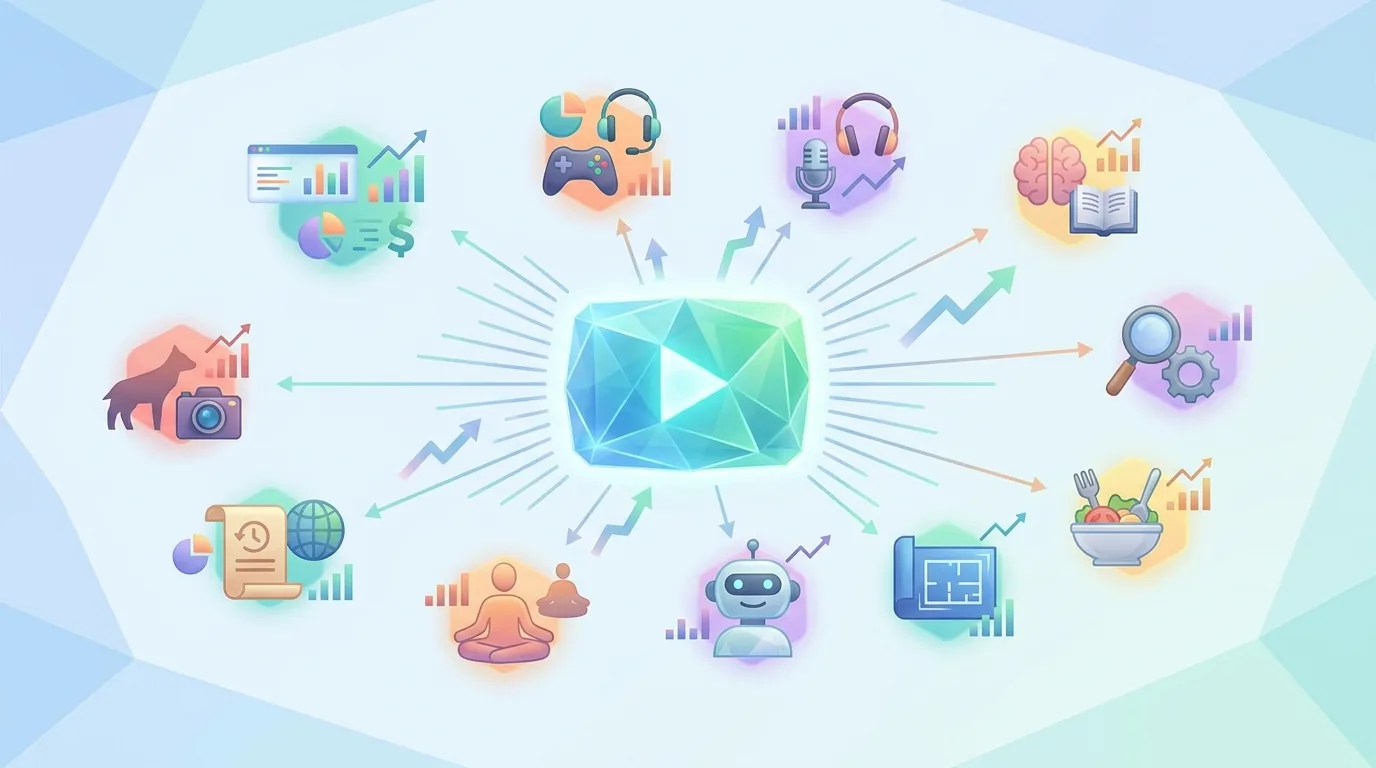
Software and technology tutorials are the best all-around faceless YouTube niche for most new creators in 2026. They are easy to demonstrate without appearing on camera, attract viewers with a specific problem, and support ads, affiliates, sponsors, templates, and services. Finance, insurance, health, and real estate may attract more valuable advertisers, but they also demand more expertise, review, and trust.
Key takeaways:
- The best niche is not the one with the highest rumored CPM. It is the one where you can publish original, useful videos for at least a year.
- Software tutorials offer the strongest balance of demand, production simplicity, and revenue options for beginners.
- Finance, insurance, health, and real estate have strong commercial intent, but mistakes in these categories can harm viewers and your reputation.
- AI-assisted channels are not automatically oversaturated. Generic formats are. Original tests, examples, research, and judgment create the difference.
How should you compare faceless YouTube niches?
Ignore universal CPM charts. YouTube explains that CPM changes with viewer geography, season, and available ad formats, while RPM measures the creator's revenue after YouTube's share across all views (YouTube Help). A niche label alone cannot predict either number.
Use five questions instead:
- Can you make 50 genuinely different videos? A niche is too thin if every title becomes the same list with new nouns.
- Can you add firsthand value? Screen recordings, calculations, original diagrams, tests, interviews, and researched examples are harder to copy.
- Does the audience solve valuable problems? A smaller audience choosing software or comparing financial concepts may support more revenue paths than a large entertainment audience.
- Can you afford the accuracy burden? Health, finance, insurance, and legal-adjacent topics require stronger sourcing and review.
- Can you produce the visuals legally? A sports or luxury channel built on footage you do not control is not a durable business.
What are the 12 best faceless YouTube niches in 2026?
| Niche | Commercial intent | Shelf life | Faceless fit | Main difficulty | Best revenue paths |
|---|---|---|---|---|---|
| Software and technology | High | Medium | Excellent | Products change | Affiliates, sponsors, ads, services |
| Education and career skills | High | Very high | Excellent | Needs a specific learner | Courses, templates, ads, memberships |
| Business case studies | High | High | High | Research quality | Sponsors, software affiliates, products |
| Productivity systems | Medium-high | High | Excellent | Generic advice is crowded | Templates, affiliates, sponsors |
| Personal finance | High | High | High | Accuracy and trust | Ads, affiliates, templates, sponsors |
| Insurance education | High | High | High | Regulation and local variation | Ads, compliant sponsors, leads where allowed |
| Senior benefits education | High | Medium-high | High | Frequent updates | Ads, education products, compliant sponsors |
| Real estate education | High | Medium-high | High | Local rules and market variation | Ads, services, sponsors, affiliates |
| Health education | High | High | High | Highest evidence burden | Ads, carefully selected sponsors |
| Science explainers | Medium-high | Very high | Excellent | Verification and clear visuals | Ads, sponsors, memberships |
| History documentaries | Medium | Very high | High | Research and media rights | Ads, memberships, sponsors |
| Luxury and premium products | Medium-high | Medium | High | Licensed visual access | Affiliates, sponsors, ads |
These ratings are editorial comparisons, not promised earnings. As a broad signal of advertiser demand, WordStream's analysis of 16,446 US search campaigns found higher median search CPCs in education, business services, health, and finance than in arts and entertainment (WordStream). Search CPC is not YouTube CPM, but it helps explain why audiences close to expensive decisions can be commercially valuable.
Commercial audience value varies by industry, but search CPC must not be presented as YouTube CPM.
| US search-ad cost per click by selected industry, 2025 | |
|---|---|
| Education and instruction | $6.23 |
| Business services | $5.58 |
| Health and fitness | $5 |
| Finance and insurance | $3.46 |
| Arts and entertainment | $1.6 |
1. Software and technology tutorials
This is the best starting point for most creators. You can record the actual workflow, show the result, and answer precise searches such as how to fix an export error or automate a recurring task. Narrow beats broad: "AI tools" is crowded, while "automation workflows for independent real-estate agents" gives the channel a clear viewer and problem.
2. Education and career skills
Choose one learner and one outcome, such as spreadsheet skills for shop owners or workplace writing for first-time managers. Worked examples, diagrams, and screen recordings create obvious original value. The content also ages well and can lead naturally to worksheets, courses, or memberships.
3. Business case studies
Company failures, pricing decisions, operational turnarounds, and product strategies work well with timelines, charts, and sourced documents. The opportunity is not retelling a company history. It is answering a sharp question with evidence: what changed, why it mattered, and what another operator can learn.
4. Productivity systems
Productivity is attractive because demonstrations are cheap and software affiliates fit naturally. It is also saturated with interchangeable advice. Bring a tested system, a before-and-after workflow, or data from your own experiment. "Five habits of productive people" is weak; "I tested three weekly planning systems on the same workload" is defensible.
5-8. Finance, insurance, senior benefits, and real estate
These four niches attract viewers making consequential decisions, which creates commercial value. They also carry the largest trust burden. Use fictional scenarios, calculators, process maps, neutral comparison criteria, and dated official sources. Explain how to think, not what one viewer should buy.
Affiliate relationships must be disclosed clearly. The FTC says disclosures should be difficult to miss and placed with the endorsement itself (FTC endorsement guidance).
9. Health education
Health can build an evergreen library, but it is a poor choice for volume-first automation. Prefer mechanisms, definitions, and conservative summaries of evidence. The FTC's health-products guidance says health-related advertising claims need competent and reliable scientific evidence (FTC health guidance). If you cannot support expert review, choose another niche.
10-11. Science and history
Both niches reward research and visual explanation rather than a visible host. Science benefits from original diagrams and simulations. History benefits from maps, timelines, and comparisons between primary and secondary sources. Their commercial intent may be lower than finance or software, but their long shelf life can make a strong catalog.
12. Luxury and premium products
Luxury works when the channel explains engineering, design, scarcity, or buyer decisions. It fails when it becomes a slideshow of borrowed images and exaggerated prices. Secure the right to use product media, add analysis, and disclose commercial relationships.
Are AI-tool and faceless niches oversaturated in 2026?
The broad category is crowded; useful sub-niches are not exhausted. Saturation is a format problem when dozens of channels publish the same AI-written list over the same stock footage. It is much less threatening when the video contains a real test, original data, a proprietary workflow, a carefully sourced case, or a distinctive visual explanation.
YouTube's monetization policy focuses on original, authentic value and identifies mass-produced or repetitive content as inauthentic. Faceless presentation and AI assistance are not, by themselves, disqualifying (YouTube monetization policies). The practical test is simple: if another channel could replace your nouns and publish the same video tomorrow, the concept needs more original input.
Which niches work best for Shorts and data visualization?
For Shorts, prioritize niches with a visual question and a fast payoff: software fixes, science mechanisms, business decisions, career micro-skills, and financial concepts. Shorts can validate hooks quickly, but long-form videos usually give complex topics more room to build trust.
For data visualization, the best fits are business case studies, personal finance education, science, history, real estate, and sports analysis. Use charts only when the relationship matters. A trend should remain a line chart; a category comparison should remain bars. Decorative 3D should never change the meaning of the data.
Which niches are best for affiliate marketing?
Software, productivity, education, premium products, and carefully governed finance content have the clearest affiliate fit because the viewer is already choosing a tool or solution. The product must solve the exact problem in the video. A large commission attached to a weak recommendation destroys the trust the channel needs to compound.
How do you test a niche before committing?
Write 30 distinct viewer questions. If the list becomes repetitive after ten, narrow or change the angle. Then produce three pilots:
- one search-led tutorial or explainer;
- one story or case study;
- one comparison built on consistent criteria.
Track click-through rate, retention, production hours, comments, and whether viewers ask useful follow-up questions. Do not choose from three videos by views alone. Choose the niche where audience response and production quality improve together.
If you need ideas, browse the free faceless video ideas library, study successful faceless channel examples, or follow the step-by-step channel launch guide. When you are ready to turn a validated topic into a complete video, GoFaceless can produce the script, voiceover, visuals, captions, and music while you keep control of the research and angle.
Frequently asked questions
What is the best faceless YouTube niche for beginners?
Software tutorials are the strongest general choice because you can demonstrate original work, target precise searches, and monetize through several relevant paths. Choose a narrow audience and workflow rather than covering technology broadly.
Which faceless YouTube niche has the highest CPM?
There is no reliable universal answer. Finance, insurance, business, health, education, real estate, and software can attract valuable advertisers, but CPM varies by viewer geography, season, video, and ad format. Validate revenue in your own YouTube Analytics.
Can a faceless AI YouTube channel be monetized?
Yes. YouTube evaluates originality and viewer value, not whether the creator appears on camera. Avoid repetitive templates, minimally transformed source material, and mass-produced videos with little educational or entertainment value.
What is the best low-competition niche?
Low competition usually comes from specificity, not an undiscovered category. Combine an audience, a problem, and a format, such as software workflows for nonprofit administrators or visual finance lessons for freelancers.
Choose the niche you can make better every month
The durable winner is not the category with the loudest income claim. It is the niche where you can research responsibly, produce legally, and make each batch of videos more useful than the last. Start narrow, test three formats, and let evidence expand the channel.
Sources & further reading
Keep reading
What RPM to Expect From Faceless Long-Form YouTube Videos
Learn realistic faceless YouTube long-form RPM ranges by niche, audience geography, language, content style, and monetisation strategy.

AI Content Disclosure Rules for Video Creators
Learn when video creators must disclose realistic AI content under the EU AI Act, TikTok policy, and IAB advertising guidance.
How to Maximize Revenue With YouTube Shorts in 2026
Maximize YouTube Shorts revenue in 2026 with Creator Pool mechanics, monetization options, length, frequency, and compliance tactics.