
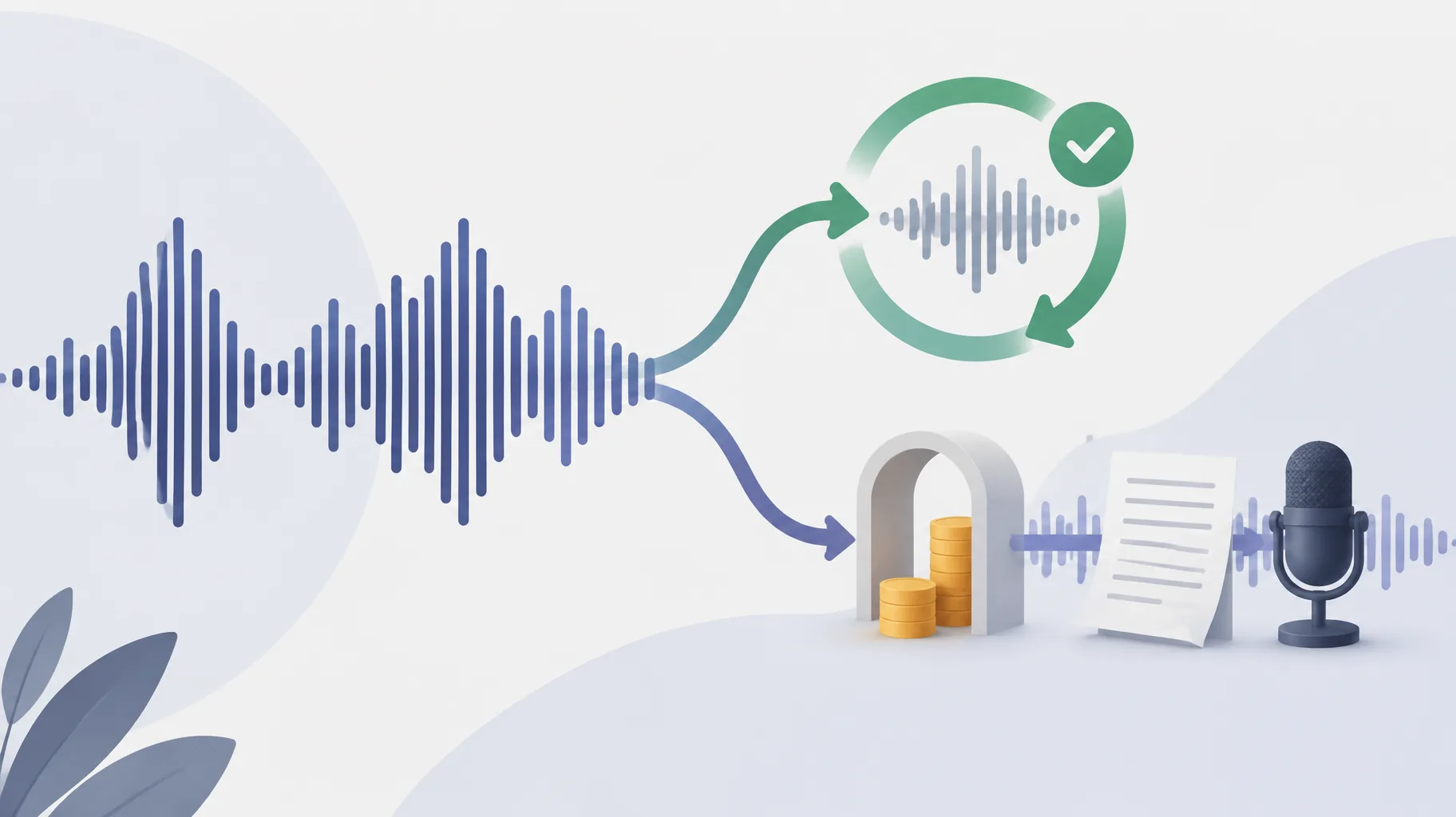
AI voiceover revision pricing is the product-specific rule set that decides whether re-rendering your narration is free or consumes new credits. In ElevenLabs Studio, regenerating unchanged text with the same voice and settings is free up to two times; rewriting a sentence or switching voices is a new, chargeable generation. Check the eligibility indicator before confirming.
Key takeaways:
- ElevenLabs Studio currently allows up to two free regenerations per voiceover when the text, assigned voice, and voice settings have not changed.
- Rewriting even one sentence produces new text, which is billed as a fresh generation rather than a free regeneration.
- The September 5, 2024 Speech Synthesis announcement used different conditions: voice-setting slider tweaks were allowed, but a two-hour window applied, refreshing the page voided eligibility, and API usage was excluded.
- Studio's interface indicates whether a regeneration is free before you confirm, so treat that indicator, not a generic "two free retries" claim, as the billing answer.
- Free-regeneration rules differ by product surface and by date, so verify the exact product you are using before assuming anything is free.
Can I regenerate the same voiceover text for free?
Yes. In ElevenLabs Studio, regenerating a voiceover costs nothing when nothing about the request has changed. The current Studio documentation allows up to two free regenerations of the same text, provided the assigned voice and the voice settings are also untouched, and the interface indicates eligibility before you commit. A free regeneration is a new delivery of identical input: same words, same voice, same settings, different performance.
This is the scenario most faceless creators actually hit. The script is fine, but the pacing on one line feels flat, or a name came out mispronounced in a way a re-roll often fixes. Requesting another take of identical text is exactly what the free allowance exists for.
Which changes are free, and which start a paid generation?
The billing line is drawn at the input, not the intention. Any edit to what goes into the generation (text, voice, or settings) ends free-regeneration eligibility under current Studio rules, while a re-render of identical input stays free up to the two-regeneration limit. The matrix below maps each common revision to its billing outcome under the current Studio documentation, with the September 5, 2024 Speech Synthesis announcement shown where it differed.
| Change you make | Free regeneration? | Why |
|---|---|---|
| Same text, same voice, same settings, new delivery | Yes, up to two in Studio | Nothing about the request changed |
| Rewritten text, even one sentence | No, billed as a new generation | The text no longer matches the original |
| A different voice | No, billed as a new generation | The voice assignment changed |
| Changed voice settings | No under current Studio rules; allowed in the 2024 Speech Synthesis announcement | The two products document different conditions |

Does changing one sentence count as a paid generation?
Yes. Editing even a single sentence means the text has changed, and changed text is a new generation rather than a free regeneration. The Studio documentation conditions free regenerations on the text being unchanged, with no partial-credit exception for small edits. A one-word fix and a full rewrite are the same billing event.
The practical consequence: batch your script corrections. If a line needs a wording change, review the whole narration for other fixes first, so one paid generation absorbs every text edit instead of triggering three separate ones.
Can I change the voice or voice settings without being charged?
Changing the assigned voice always ends free-regeneration eligibility, because the voice is one of the three conditions (text, voice, settings) that must stay identical. Voice settings are subtler. Under the current Studio documentation, settings must remain unchanged for a regeneration to be free. The older Speech Synthesis announcement explicitly permitted slider adjustments while keeping text, voice, and model fixed. So a settings tweak that was free in a 2024 Speech Synthesis workflow can be chargeable in Studio today.
How many free regenerations does ElevenLabs Studio allow?
ElevenLabs Studio allows up to two free regenerations per generation, and its interface indicates whether a given regeneration qualifies before you confirm it, per the Studio help-center documentation. Two is the ceiling, not a per-edit allowance: after both are used, further re-renders of the same text consume credits like any new generation.
Treat the two free takes as delivery insurance, not as an editing budget. They cover "same script, better read," nothing more.
Do the same free-regeneration rules apply in Studio, Speech Synthesis, and the API?
No, and the differences are the most useful lesson in this article. The September 5, 2024 Speech Synthesis announcement allowed voice-setting slider adjustments but required unchanged text or file, voice, and model; it also imposed a two-hour window, voided eligibility if you refreshed the page, and excluded API usage entirely. The current Studio documentation describes no two-hour window or refresh rule, but it does require unchanged voice settings, which the 2024 announcement did not.
A creator who read the 2024 announcement and assumed "two free retries, sliders allowed" as a permanent platform-wide rule would misjudge a Studio regeneration in 2026. Product surfaces evolve separately, and old announcements stay discoverable long after they stop describing current behavior. Verify the exact product, in its current documentation, before trusting any generic claim, including ones that were accurate when published.
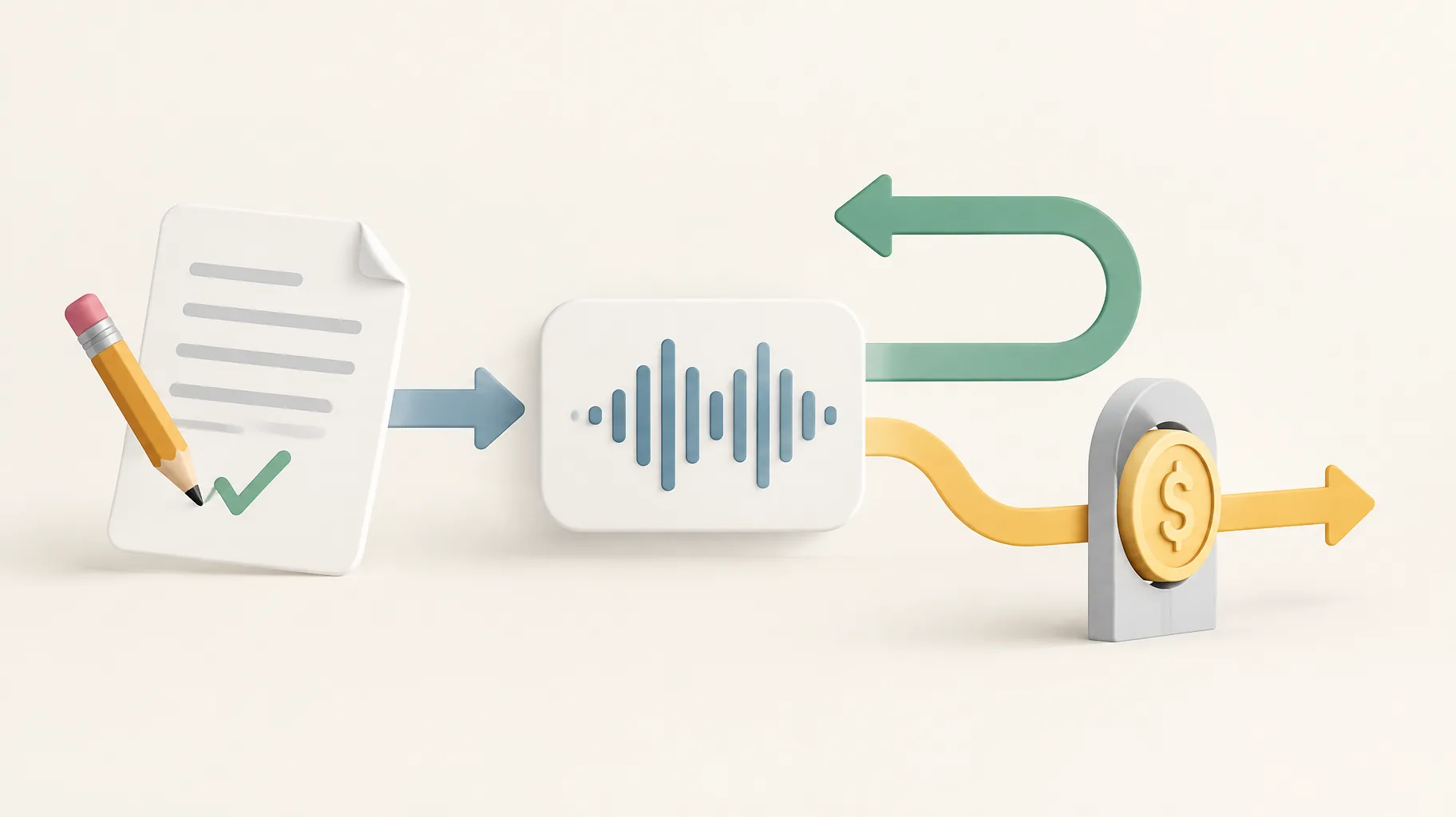
How can I tell whether my next regeneration will be charged?
Studio tells you directly: its interface indicates regeneration eligibility before you confirm, according to the Studio documentation. Before clicking, run a three-part self-check against the free-regeneration conditions:
- Text: is every word identical to the original generation?
- Voice: is the same voice still assigned?
- Settings: are all voice settings untouched?
If all three answers are yes and you have used fewer than two regenerations, the re-render should be free. If any answer is no, expect a charge. When the indicator and your expectation disagree, trust the indicator and re-check which product surface you are actually on.
How do I keep voiceover revisions from eating my credit budget?
The cheapest revision is the one you never need, and most paid revisions trace back to generating audio before the script was final. Approve the narration text first, then generate. After that, separate the two kinds of fixes: script corrections (new text, always a new generation) from delivery changes (same text, potentially free). Batching all wording edits into one regeneration keeps a correction round to a single charge.
Generation wait time is also usable review time. In a June 9, 2026 interview, filmmaker Kévin Mendiboure described overlapping rendering with quality control: "I used that waiting time to edit, review continuity, and refine upcoming shots." The same habit works for narration: proofread the next section while the current one renders. A structured two-hour production workflow builds this kind of approval gate in by default, and it is worth checking any AI video tool's revision policy before committing to it. One way to enforce script-first approval is to finalize narration inside a faceless-video platform such as GoFaceless before any audio is generated, so text changes happen upstream of the metered step.
Lock the script before you spend a credit
GoFaceless (our own product) generates script, voiceover, visuals, and captions in one pass, so you can approve the narration text before audio enters the pipeline. Plans start at $29 per month on the pricing page.
Sources & further reading
Keep reading

Can You Get AI Video Credits Back for an Unusable Clip?
Runway refunds credits automatically for generation errors, but completed clips that miss your prompt still cost credits. Here is the decision tree.

TikTok Performance Saturation: What It Means for Faceless Creators
TikTok views and interactions are declining year over year. Learn how faceless creators can adapt formats, retention, testing, and distribution.

AI Content Disclosure Rules for Video Creators
Learn the AI content disclosure rules for YouTube, EU audiences, advertising, labels, monetization, and realistic AI-generated visuals.