
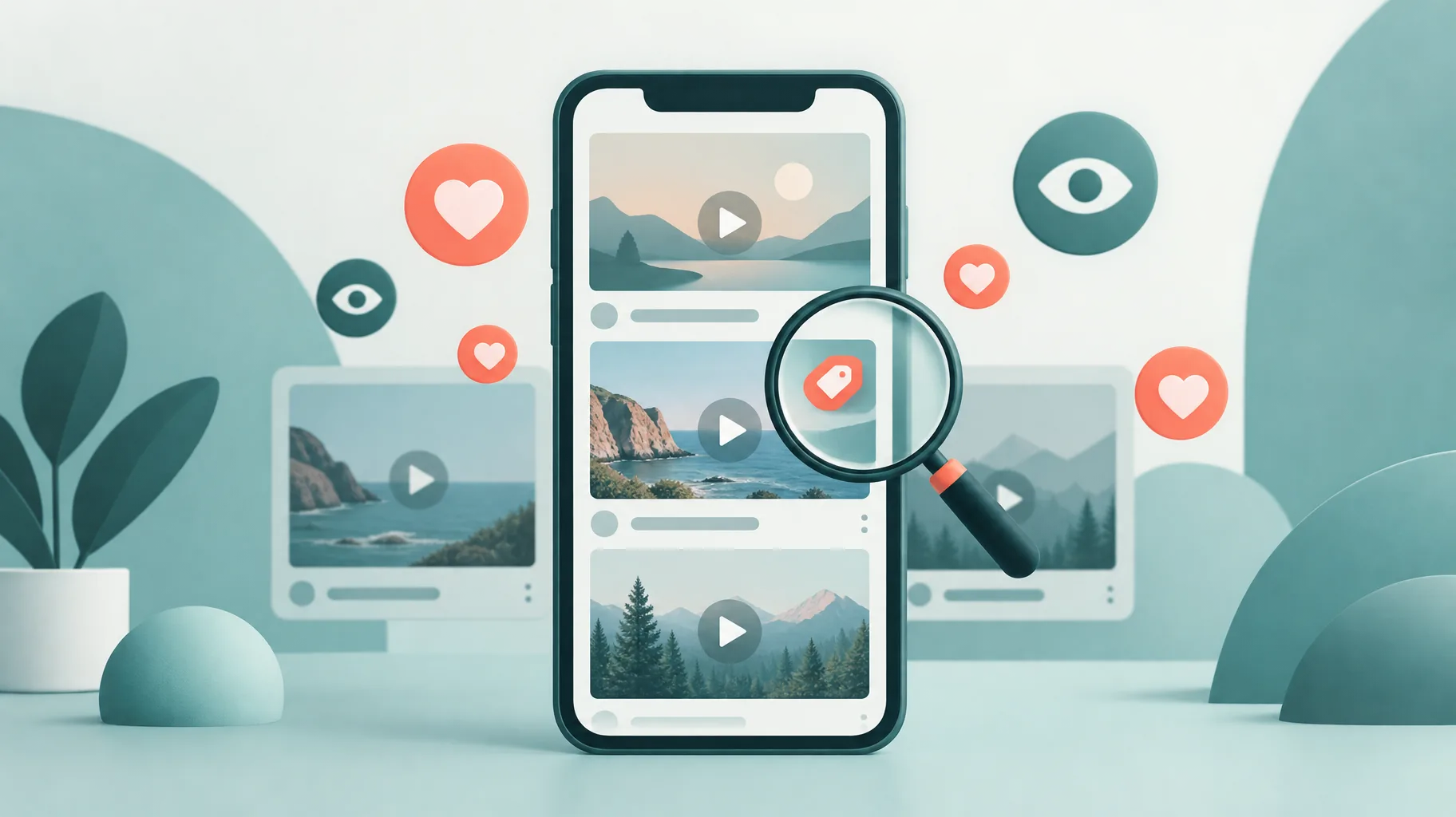
An AI label is a platform disclosure marking a video as made or altered with AI, and the evidence says it changes how viewers respond more than how platforms distribute: a study of 1,135,817 TikTok posts found roughly 7% fewer combined engagement for AI-disclosed posts at the same view count, while YouTube states labels alone do not affect recommendations.
Key takeaways:
- A May 7, 2026 Journal of Consumer Research study of 1,135,817 TikTok posts from 8,650 creators found approximately 7%-8% fewer likes and 7% less combined engagement for AI-disclosed posts, conditional on the same number of views.
- In a controlled experiment with 198 participants, mean liking intent was 3.17 with a generic AI disclosure versus 3.98 with no disclosure on a seven-point scale.
- TeamYouTube stated on May 27, 2026: "Applying these labels alone will not impact a video's recommendations or its eligibility for monetization."
- The TikTok figures are observational estimates, not proof of algorithmic suppression and not a forecast for YouTube.
- You can measure your own label effect by comparing engagement per view across similar videos, without ever skipping a required disclosure.
Does an AI label reduce reach, or can it reduce engagement at the same view count?
An AI label can reduce engagement at the same view count, which is exactly what the TikTok data shows: the reported 7%-8% fewer likes were measured conditional on views, meaning labeled and unlabeled videos were seen by comparable audiences but viewers reacted differently. That distinction matters because it separates three mechanisms creators often blur together.
Mechanism 1: Platform distribution penalty. The platform shows the video to fewer people because it carries a label.
Mechanism 2: Viewer response. The same number of people see the video, but fewer like, comment, or share after noticing the label.
Mechanism 3: Video differences. Labeled videos differ from unlabeled ones in topic, quality, or creator, and those differences drive the engagement gap.
The TikTok finding isolates mechanism 2: at equal views, engagement still dropped. That is evidence of an audience reaction, not a shadowban. If your views collapsed after labeling, that is a different problem than if views held steady but likes dipped.

What did the study of more than one million TikTok posts actually find?
The study Made With AI, published May 7, 2026 in the Journal of Consumer Research, analyzed 1,135,817 TikTok posts from 8,650 creators and reported approximately 7%-8% fewer likes and 7% less combined engagement for AI-disclosed posts, conditional on the same number of views. The researchers then ran a controlled experiment with 198 participants to test whether the disclosure itself caused the reaction.
In that experiment, participants rated their likelihood of liking a post on a seven-point scale. The means were 3.17 with a generic AI disclosure, 3.85 with a Photoshop neural-filter disclosure, and 3.98 with no disclosure at all. The gap between the Photoshop disclosure and no disclosure was not statistically significant, while the generic AI label produced a clearly lower score.
A generic AI label depressed liking intent far more than a tool-specific Photoshop disclosure, which was statistically indistinguishable from no disclosure.
| Mean likelihood of liking a post by disclosure type (7-point scale) | |
|---|---|
| Generic AI disclosure | 3.17 |
| Photoshop neural-filter disclosure | 3.85 |
| No disclosure | 3.98 |
Does the research prove that TikTok suppresses AI-labeled videos?
No. The observational half of the study measured engagement conditional on views, so it cannot show whether TikTok's algorithm distributed labeled videos less in the first place. The controlled experiment tested viewer psychology, not feed ranking. Nothing in the paper demonstrates a distribution penalty, and the authors' design was built to separate audience reaction from exactly that confound.
There is also a selection problem: creators choose which videos to label, and platforms auto-apply labels to content their systems flag. Labeled videos may differ systematically from unlabeled ones in ways no view-count adjustment fully captures. Treat the 7%-8% figure as evidence that audiences respond to labels, not as a measurement of any algorithmic penalty.
Can the TikTok findings predict how an AI label will affect YouTube videos?
No, and YouTube's own statement points the other direction on distribution. On May 27, 2026, TeamYouTube stated: "Applying these labels alone will not impact a video's recommendations or its eligibility for monetization." That addresses mechanism 1 directly for YouTube.
Viewer response (mechanism 2) could still carry over, since the psychology of seeing "AI" and trusting the content less is platform-independent. But TikTok's audience, format, and label placement differ from YouTube's, so the 7% figure is not a transferable benchmark. If you are weighing whether a visible label explains a YouTube dip, check retention and per-view engagement before assuming the label did it. A retention spike or drop often says more about the video than about any disclosure.
Did viewers react differently to generic AI and Photoshop disclosures?
Yes, sharply. In the 198-participant experiment, the generic AI disclosure scored 3.17 on the seven-point liking scale while the Photoshop neural-filter disclosure scored 3.85, nearly matching the 3.98 for no disclosure. The Photoshop-versus-no-disclosure difference was not statistically significant.
The practical read: viewers did not punish disclosure itself. They punished the generic "AI" framing. A specific, tool-level disclosure describing a familiar editing process landed almost like no label at all. This suggests audience skepticism targets the vague idea of AI-generated content, not honest description of how a video was made. That is a reason to make your content genuinely good and your disclosures accurate, never a reason to disclose less than platforms require.

How can I evaluate my own engagement without skipping required AI labels?
You evaluate the label effect by normalizing engagement per view across comparable videos, all properly disclosed. The label stays on every video that requires it; what varies is everything else, so you can see whether labeled content underperforms for reasons you control.
Step 1: Build a matched set. Pick 10-20 videos on similar topics, lengths, and formats. Consistent structure matters here; some creators use an AI faceless-video platform such as GoFaceless (our own product) to keep scripting, voiceover, and caption style uniform so the videos are actually comparable.
Step 2: Compute engagement per view. Likes plus comments plus shares, divided by views, for each video. This mirrors the study's conditional-on-views logic.
Step 3: Compare within the set. If all videos carry similar disclosures, per-view differences reflect creative execution, not the label. If engagement is uniformly low, the problem is the content, and resources like a library of proven video hooks address that more directly than disclosure tweaks.
Step 4: Change one variable at a time. Hook, pacing, topic. Re-measure. If you suspect TikTok's auto-label was applied wrongly, that is a separate issue with its own appeal and removal process.
What not to do: withhold a required disclosure to run an unlabeled "control." That violates platform rules, and the study suggests accurate, specific disclosure is not what viewers punish anyway.
The bottom line on AI labels and engagement
The honest answer to "do AI labels reduce engagement" is: modestly, through audience reaction, with no verified evidence of platform suppression. A 7% per-view engagement dip is real but small, and the experiment shows specific, accurate disclosure barely moves viewers at all. Your lever is creative quality measured per view, not label avoidance.
If you want a consistent production baseline for running these comparisons, GoFaceless turns a topic into a finished short-form video (script, voiceover, visuals, captions) in one pass, so structure stays constant while you test hooks and topics. See plans and pricing.
Sources & further reading
Keep reading

AI Content Disclosure Rules for Video Creators
Learn the AI content disclosure rules for YouTube, EU audiences, advertising, labels, monetization, and realistic AI-generated visuals.
How to Find an AI YouTube Niche in a Saturated Market
Find an AI YouTube niche by measuring competition, validating demand, differentiating your format, and following AI disclosure rules.

How to Respond to a YouTube AI-Likeness Privacy Complaint
Received a YouTube privacy complaint about an AI face or voice? Follow this uploader-side procedure: assess, edit, or remove. Disclosure and privacy settings are not enough.