

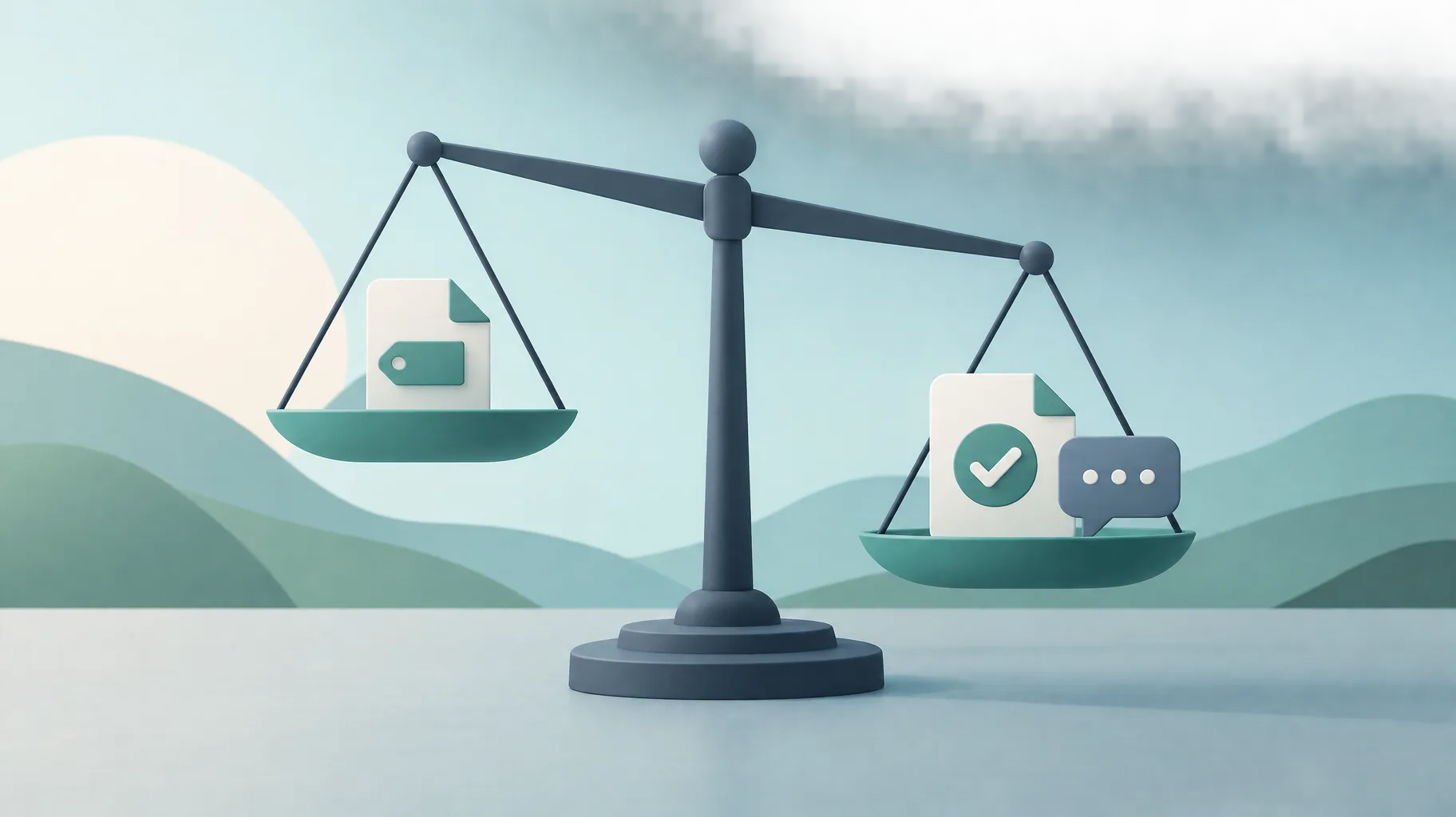
An AI-generated label is a statement about how a piece of media was made, not a verdict on whether what it says is true. A labeled video can contain accurate, well-sourced information, and an unlabeled video can be false. Treating the label as a fact-check confuses provenance with accuracy, two questions that require completely different checks.
Key takeaways:
- An AI-generated label answers "how was this made?" — it says nothing about whether the video's claims are true or false.
- On May 9, 2024, TikTok began using C2PA Content Credentials to auto-label AI-generated uploads from participating platforms, based on file metadata rather than visual detection.
- Two preregistered experiments with 7,579 Americans found AI labels reduced belief in misleading image posts, but the studies never tested whether labels can sort true claims from false ones.
- The absence of a label proves nothing: TikTok's own documentation states that no automatic label does not remove a creator's self-disclosure obligations.
What does an AI-generated label actually tell a viewer?
An AI-generated label tells a viewer one thing: the content, or part of it, was created or altered with AI tools. It is a provenance signal, comparable to a "filmed on location" note — it describes production method, not truth value. A labeled history explainer can be rigorously accurate; an unlabeled clip can be fabricated. The label carries no information either way.
This distinction matters because platforms themselves frame labels as transparency, not verification. When TikTok announced its AI labeling expansion on May 9, 2024, it described the goal as advancing "AI transparency and literacy" — giving viewers context about origin so they can judge content themselves. The announcement did not claim the label flags falsehoods, and it did not claim universal synthetic-media detection.
So when a viewer asks "does an AI-generated label mean fake," the honest answer is that the question mixes up two separate judgments:
- Provenance: Was synthetic media involved in production? The label addresses this.
- Accuracy: Are the claims in the script, captions, and visuals supported by evidence? Only independent verification addresses this.
- Belief: Will viewers accept the claims? That depends on the viewer, the claim, and the context — not on the label alone.

Can a label be applied because of file metadata rather than the video's appearance?
Yes. TikTok's automatic labeling reads metadata embedded in the file, not the pixels. Its May 2024 announcement described using C2PA Content Credentials — a tamper-evident metadata standard that records how content was produced — to automatically label AI-generated images and videos uploaded from participating external platforms. The system reads a credential traveling with the file; it is not scanning the video and deciding it "looks AI."
That design has two practical consequences. First, a photorealistic AI video exported without Content Credentials from a non-participating tool may carry no automatic label at all. Second, a video can be labeled even when nothing about it looks synthetic, because the metadata says an AI step occurred. Neither outcome tells you anything about accuracy — both are artifacts of the metadata pipeline.
If you are a creator wondering why a label appeared on your upload, that is a provenance question with its own mechanics, covered in why TikTok auto-adds an AI label and when it can be removed. The point here is narrower: metadata-based labeling is a production record, and a production record is not a fact-check.
How is identifying synthetic media different from fact-checking its claims?
Identifying synthetic media is a classification task: did AI generate or alter this content? Fact-checking is an evidentiary task: is each claim supported by reliable sources? The two share almost no workflow. A label system can complete the first task perfectly — flagging every AI-assisted upload — while doing nothing for the second.
Consider a concrete case. A faceless channel publishes a labeled AI video claiming a historical event happened in a specific year. The label correctly reports that the visuals are synthetic. The date in the script could still be wrong, and no labeling system on any platform checks it. Conversely, an unlabeled video shot on a phone could repeat a fabricated statistic, and its authentic footage would make the false claim more persuasive, not less.
This is why the verification burden sits with the creator and the viewer, not the label. Creators who use AI for product demonstrations face a sharper version of this: TikTok Shop documentation updated September 2, 2026 permits accurate illustrative virtual scenes and animations but prohibits before-and-after visuals that compress time or imply instant results without reliable supporting evidence. An accurately rendered demo can still make an unsupported claim through editing speed — a factual problem no provenance label will catch. The same logic drives how to build an AI product demo without inventing proof.
What did the AI-label experiments measure about viewer belief?
The experiments measured whether labels change how much people believe and share specific misleading posts — not whether labels can distinguish truth from falsehood. Wittenberg and colleagues ran two preregistered survey experiments with 7,579 Americans, showing social posts that contained misleading AI-generated images. The study found that labels reduced belief in the posts' claims, and in the second experiment a standalone label had no statistically significant effect on stated willingness to share.
Three limits define what this research does not say:
- The stimulus was misleading by design. Every post contained a misleading image, so reduced belief was the desired outcome. The design never tested labels on accurate content.
- The measures were self-reported. Participants stated belief and sharing intentions in a survey; the study did not observe real video performance, retention, or revenue.
- The content was image posts, not entertainment video. Results do not automatically transfer to ordinary Shorts, Reels, or TikToks.
The correct reading: labels can dampen belief in a specific post, which is exactly why viewers should not outsource judgment to them. A label that lowers belief in a true claim has done harm; a label that lowers belief in a false claim has done good — and the label itself cannot tell you which happened. For the separate question of how labels affect watch behavior, see what the research shows about AI labels and engagement.
Can I assume an unlabeled video is authentic or accurate?
No. An unlabeled video may be authentic, or it may be synthetic content whose metadata was stripped, never embedded, or produced by a tool outside the participating-platform system TikTok described in May 2024. Absence of a label is absence of a metadata signal, nothing more. TikTok Shop's own documentation states that the lack of an automatic AI label does not eliminate applicable creator self-disclosure obligations — the platform itself treats the automatic system as incomplete.
For viewers, the rule is symmetric: label or no label, evaluate the claim. For creators, the rule is stricter: you are responsible for disclosure even when no automatic label appears, and you are responsible for accuracy regardless of disclosure.
Which claims should I verify separately before publishing a labeled AI video?
Verify every factual assertion in the script, every implied claim in the visuals, and every number in the captions — before assembly, not after. The label will describe your production method honestly; only your own checking makes the content honest. A practical pre-publish checklist for a faceless explainer:
- Named facts: dates, statistics, quotes, and attributions, each traced to a primary source.
- Implied visual claims: does a generated scene depict something that did not happen, or compress a timeline the way TikTok Shop's September 2, 2026 guidance prohibits for product results?
- Voiceover-script match: does the narration say what the sourced script says, with no drift introduced during generation?
- Disclosure status: is synthetic content disclosed where required, independent of whether an automatic label appeared?
Keeping the source links and script versions for each video makes this auditable later; the specific records worth saving are laid out in the production records to keep for every AI-assisted video.
One way to operationalize this is to treat your production tool as a production tool. GoFaceless (our own product) assembles script, voiceover, visuals, and captions into a finished short video — it is not a truth-verification service, and no generator is. The workable pattern is to verify claims and source material first, then generate, then disclose synthetic visuals appropriately. Accuracy is an input to the pipeline, not an output of it.
The bottom line
An AI-generated label is a provenance label. It tells viewers how a video was made so they can bring their own judgment to what it claims. Creators who verify claims before assembly and disclose synthetic media honestly give that label its correct meaning: transparent about method, silent about truth — because truth was checked separately.
If you want a faster path from a verified brief to a finished, properly disclosed faceless video, GoFaceless handles the script, voiceover, visuals, and captions in one pass, with plans from $29/mo on the pricing page. You bring the fact-checking; it handles the assembly.
Sources & further reading
Keep reading

Why Did TikTok Auto-Add an AI Label, and Can You Remove It?
TikTok auto-labels videos carrying C2PA Content Credentials, and its Help Center says you cannot remove an automatic AI label. Here is what actually happened.
How to Fact-Check Social Media Growth Statistics Before Changing Your Strategy
A repeatable 5-step audit for social media growth statistics: check the denominator, outcome, dates, metric definitions, and causation before changing strategy.

Why Did One AI Video Generation Show Both a Charge and a Refund?
A charge plus a partial refund on one AI video generation is normal settlement: a maximum-cost hold, then unused credits returned. Here's how to reconcile it.