

Start a faceless YouTube channel in 2026 by beginning with one narrow niche—such as helping new freelancers avoid client mistakes—using a repeatable 30-second narrated scenario format, and running a 30-day test plan: publish one original Short each day, group the videos into three to five viewer-question themes, review responses every seven days, and turn the clearest winning question into a deeper video. Use AI to speed up drafts and production, but make the topic, evidence, script decisions, and final review your own so every upload provides distinct value and remains eligible for monetization.
Key takeaways:
- YouTube Shorts receive over 70 billion daily views, making Shorts a practical discovery format for a new faceless channel.
- YouTube updated its inauthentic-content policy on July 15, 2025, and mass-produced or repetitive template content is not eligible for monetization.
- Shorts ad revenue requires creators to accept the Shorts Monetization Module; creators receive 45% of their allocated revenue.
- A 30-day sprint is most useful as a learning system: test original questions and openings, document what changes, and use results to choose the next set of videos rather than expecting a guaranteed growth outcome.
What are the benefits of starting a faceless YouTube channel?
A faceless YouTube channel lets a creator build around a subject, storytelling format, or useful point of view instead of personal on-camera presence. The practical advantage is that filming is no longer the central production constraint: narration, screen recordings, licensed footage, original diagrams, animation, and designed visual sequences can all carry the explanation. The lasting benefit is not anonymity by itself. It is the ability to make a specific promise to a specific viewer and deliver that promise consistently, even when the creator never appears on screen.
1. Recommendation: Define one audience, one outcome, and one repeatable format before designing the channel.
What it requires: Write a sentence such as, “I help new freelancers understand client mistakes through 30-second narrated scenarios.” That sentence contains a viewer, a problem, and a format. Avoid broad promises such as “motivation,” “AI news,” or “interesting facts,” because they do not tell you what to research, which videos belong together, or why someone should return after one upload.
How to tell it worked: A stranger can describe who the channel is for, what viewers receive, and why they would return after reading the sentence. You should also be able to turn the promise into at least 10 distinct video questions without changing the audience. For the freelancer example, those questions could cover unclear scopes, unpaid revisions, late invoices, vague briefs, and difficult client feedback.
A focused format makes quality control easier because you can repeat the production system without repeating the substance. A consistent narrator, visual style, opening rhythm, and series structure are useful. A stream of nearly identical scripts with names, images, or captions swapped out is not. Start with an intentionally modest production setup: one voice style, one caption treatment, one visual language, and one clear topic pillar. Improve those choices only after viewers have given you evidence that the underlying topic is worth developing.
For a first 30-day plan, choose three to five subtopics within the same audience problem and assign roughly a week of publishing to each. A freelancer channel might spend its first seven uploads on client boundaries, its next seven on project pricing, and its next seven on communication mistakes. The remaining uploads can revisit the questions that earned the strongest comments or clearest viewer response. If you need help choosing a viable topic before committing, use these faceless video topic ideas by niche to generate angles, then validate them against real viewer questions and your own knowledge.
How can I monetize my faceless YouTube channel in 2026?
A faceless YouTube channel can monetize through YouTube Partner Program revenue, affiliate recommendations, sponsorships, services, digital products, or audience-supported offers, but every income source depends on original audience value. For Shorts ad revenue, a creator must accept YouTube’s Shorts Monetization Module, which pays creators 45% of the revenue allocated to them after the Shorts revenue-sharing process. Treat ad revenue as one possible income stream rather than the whole business model, especially while a new channel is still learning which viewer needs it serves best.
2. Recommendation: Choose the monetization path that matches the viewer’s immediate next step.
What it requires: Work backward from what a satisfied viewer would reasonably need after watching. A study-skills channel might eventually recommend relevant tools or sell a study template. A business-explainer channel might develop sponsorship inventory or a research product. A freelancer channel could lead to a useful checklist, a service, or carefully disclosed recommendations. The offer should extend the video’s value rather than interrupt it with something unrelated.
How to tell it worked: Every promotion can be explained as useful to a viewer who just watched the video, even if that viewer never buys it. If you cannot connect the recommendation to the topic in one plain sentence, it is probably too early, too broad, or not relevant enough to that audience.
It helps to distinguish a channel’s discovery format from its revenue format. A 30-second Short may introduce a problem, such as a vague client brief. A longer video can explain how to evaluate a brief, show a practical framework, and answer common objections. A template, service, or affiliate recommendation—where appropriate and disclosed—should then solve the next logical problem rather than appear as an arbitrary sales message. This sequence gives the audience useful value at every stage.
Apply for YouTube monetization only when your channel meets the applicable program requirements, and keep records for licensed visuals, music, and affiliate relationships. For a deeper breakdown of revenue paths and program mechanics, see how to monetize with YouTube Partner Program in 2026. A small, trusted audience with a relevant offer can be more durable than a channel that depends entirely on unpredictable viral views, because relevance gives viewers a reason to act beyond simply watching one clip.
What are YouTube's current policies on AI-generated content?
YouTube does not make AI-generated content automatically ineligible for monetization; YouTube evaluates whether a channel’s output is original, authentic, and compliant with relevant disclosure rules. YouTube’s monetization policy was updated on July 15, 2025, and YouTube’s official policy states, “Inauthentic content is content that is mass-produced or repetitive.” That standard matters more than whether a video uses an AI voice, AI visuals, AI-assisted writing, or conventional production tools.
3. Recommendation: Test every series for meaningful differences before batch-producing it.
What it requires: Make each script answer a different question, use distinct examples, and ensure the narration adds commentary, analysis, or a useful explanation. Do not create a large set of videos by changing only names, images, locations, or captions in the same underlying script. If a series uses the same framing device—for example, “one client mistake in 30 seconds”—the lesson, evidence, and conclusion still need to change from episode to episode.
How to tell it worked: A viewer who watches three uploads can identify a different takeaway, example, or argument in each one. You should be able to write a one-sentence answer for each video that does not fit any of the other scripts. If several answers sound interchangeable, the series needs more research or a narrower editorial angle before you produce it at scale.
A practical way to apply this policy is to separate reusable production elements from reusable editorial substance. Reusing a caption style, voice workflow, color palette, or title convention can make a channel recognizable. Reusing the same claim, progression, and conclusion with superficial substitutions creates a much greater risk of repetitive output. AI can generate possible angles quickly, but the creator should decide which question matters, what evidence supports it, and whether the finished video says anything genuinely different.
YouTube also has an altered-content disclosure process for realistic synthetic or altered material. Creators should use the relevant YouTube setting when a video could make viewers believe a real person, event, or place did something that did not happen; YouTube explains its approach to AI labels for viewers and creators. This is an official source for the disclosure approach. Treat informal creator discussions as ideas for questions to investigate, not as substitutes for YouTube’s policy pages or settings.
How can I ensure my content remains authentic and complies with YouTube's policies?
Authentic faceless content has a visible human editorial layer even when viewers never see the creator: someone selects the topic, verifies claims, shapes the argument, decides what to omit, and chooses visuals that help the audience understand. YouTube’s inauthentic-content policy targets mass-produced and repetitive output, not the absence of a face on screen. A channel is more defensible when every video has a clear reason to exist beyond filling a publishing quota or following an automated schedule.
4. Recommendation: Use a pre-publish checklist for originality, accuracy, rights, and disclosure.
What it requires: Check the factual claim, source material, visual rights, music rights, disclosure need, title accuracy, and whether the script contains your own explanation. Remove stock clips that merely decorate the narration when a diagram, worked example, or relevant screen recording would teach better. Check whether each visual reinforces the exact sentence being spoken; if it does not, it may make the video feel generic even when the script is sound.
How to tell it worked: You can state the video’s unique claim in one sentence and identify where every important fact, asset, and sound came from. You should also be able to explain why the title is supported by the video rather than merely designed to attract a click. This review does not need to be complicated, but it should happen before export, not after a video has already been published.
Keep a lightweight production record with script drafts, research notes, licenses, and disclosure decisions. For a Short, that record may be a folder containing a brief, final script, source links, asset licenses, and export date. For a longer video, it may also include timestamps for major claims and notes on footage use. The purpose is not bureaucracy. It is to make your quality decisions repeatable and to reveal patterns, such as recurring unsupported claims or visuals that do not carry their share of the explanation.
For a practical explanation of the altered-content setting and common disclosure decisions, read how to label AI videos on YouTube and stay compliant. Do not confuse disclosure with permission to mislead: labels support transparency, while the content must still avoid deception and rights violations. When in doubt, make the video’s editorial purpose clearer, reduce realistic synthetic elements that could confuse viewers, and review YouTube’s own guidance before publishing.
What practical steps should I take to grow a faceless channel quickly?
A faceless YouTube channel grows most reliably when the creator runs short feedback loops: publish a focused idea, study the response, improve one variable, and repeat. “Quickly” should describe the speed of learning rather than a promised subscriber or view total. Shorts are especially useful for this because YouTube reports over 70 billion daily views, but that platform-wide number is not a forecast for any individual upload. A new channel still needs a clear idea, a relevant opening, and a reason for the viewer to keep watching.
5. Recommendation: Run a documented 30-day testing sprint around one content pillar.
What it requires: Build a list of at least 30 viewer questions within one niche, then publish several distinct answers while keeping the audience promise stable. For example, use 10 questions about a problem, 10 questions about common mistakes, and 10 questions about solutions. Track the opening, subject, pacing choice, ending, comments, and signs of returning interest for each upload. Change one major element at a time so the results remain interpretable.
How to tell it worked: By the end of the sprint, you can name two or three topics and opening styles that consistently outperform your channel’s other uploads. You should also know which topics generated useful follow-up questions, not merely which received the most fleeting attention. A video that prompts viewers to ask for an example, clarification, or part two can provide a stronger editorial direction than a video with no identifiable audience need behind it.
Use a simple comparison sheet rather than relying on memory. For each Short, write the topic, first sentence, visual device, final resolution, and one lesson from the response. If two videos cover the same subject but one opens with a concrete scenario and the other starts with a general statement, you can compare those openings without assuming that every other production choice caused the result. If a topic performs weakly, do not automatically conclude that the niche is wrong; test a different question, example, or framing before abandoning it.
Use comments as research. Turn recurring objections into follow-up videos, then make the next video clearer than the comment thread. Improve retention with direct openings, visual changes that serve the explanation, and an ending that resolves the promise made in the first seconds. The tactical details in these YouTube Shorts retention benchmarks can help you diagnose where viewers leave, but do not chase a benchmark at the expense of a useful story. A complete answer to a real question is more valuable than an artificially stretched clip.
How do AI-powered tools enhance content creation for YouTube?
AI-powered tools enhance faceless YouTube production by reducing the time between an idea and a reviewable draft. They can assist with research outlines, script alternatives, narration, visual planning, captions, and first-pass edits, which can leave more creator time for accuracy and creative direction. The important boundary is editorial responsibility: AI can propose material, but the creator still needs to verify facts, choose the point of view, check rights, and reject output that is vague, repetitive, or misleading.
6. Recommendation: Put a human approval point after every major production stage.
What it requires: Start with a brief containing the audience, claim, evidence, hook, and desired viewer action. Review the script before voiceover, review visual relevance before export, and watch the complete video with sound and captions before publishing. If the tool produces several versions, compare them against the brief instead of choosing the quickest one by default.
How to tell it worked: The final video contains specific examples and purposeful visual choices rather than generic narration placed over unrelated footage. A viewer should be able to see that the visual sequence was selected to explain the idea, not simply to fill the screen while an automated voice reads a broad script.
Use automation for repeatable mechanical work, not unchecked publishing. For example, ask an AI tool for five hook directions, then choose the one that makes the strongest accurate promise. Ask for a first-pass outline, then add the example or counterexample that proves the point. A tool can produce a caption file quickly, but you should still correct names, numbers, timing, and punctuation. This division of labor supports a consistent cadence while preserving the creative input and quality review YouTube expects.
A useful production sequence is brief, research, script, visual plan, draft, review, and publish. The sequence matters because it prevents a common failure mode: generating a polished-looking video before deciding whether its central claim is worthwhile. If the brief cannot name the audience, the question, and the useful answer, pause before creating visuals. Better inputs make AI assistance more useful; they also make the final content more clearly original.
What are the best practices for using YouTube Shorts in my strategy?
YouTube Shorts should function as a discovery system for a faceless channel, not as a random collection of vertical clips. Shorts receive over 70 billion daily views, which shows the scale of the format, but the creator-facing implication is practical rather than predictive: each Short is a low-commitment opportunity to test one question, one framing, and one payoff. Make every Short complete on its own while connecting it to a recognizable series or a deeper video.
7. Recommendation: Build each Short around one promise, one development, and one resolution.
What it requires: State the viewer’s benefit immediately, deliver only the evidence needed to support it, and close with the answer, lesson, or next relevant question. In a freelancer scenario, a Short might open with “A client who says ‘make it pop’ has not given you a usable brief,” develop the specific missing information, and resolve with the exact question to ask next. Cut any scene that does not create understanding, tension, or proof.
How to tell it worked: A viewer can understand the core point without reading the description, and the ending feels earned instead of abruptly cut off. The Short should not require an unrelated part two to deliver its promised answer. If a larger topic needs more evidence, make the Short a complete entry point and create a companion longer video for the additional depth.
The 70-billion-daily-views figure is a platform-wide context, not a reason to publish 70 variations of the same script. A more useful 30-day comparison is 30 different questions for one audience. That gives you 30 chances to learn which questions create interest while preserving enough consistency to recognize a pattern. For instance, three different openings about unclear client briefs can test scenario-led, mistake-led, and solution-led framing; each should still deliver a distinct insight rather than recycling the same conclusion.
Design the first moments before polishing transitions. If you need ideas to test, use the free library of 3,500+ proven video hooks as a prompt source, then rewrite every hook for your own audience and claim. Create companion long-form videos when a Short raises a question that needs evidence, a demonstration, or a fuller tutorial. Shorts can test demand; longer videos can build deeper trust and give existing viewers a reason to subscribe.
What can I learn from successful faceless channels?
Successful faceless channels usually succeed because their formats are recognizable, their claims are clear, and their videos give viewers a reason to return. The useful lesson is not to imitate another creator’s exact visuals, upload volume, assets, or identity. Instead, study the mechanics beneath the surface: the audience promise, topic-selection pattern, first seconds, narrative sequence, proof style, and the way each video leads naturally to another original question.
8. Recommendation: Reverse-engineer three channels for structure, then design an original alternative.
What it requires: For each channel, note the audience, recurring question, title pattern, first visual, narrative sequence, proof style, and call to action. Then write an alternative video that serves a different angle or audience need. If another channel explains a common freelancer mistake through a list, you might use an anonymized scenario, a decision tree, or a screen-recorded walkthrough instead—provided the new version is based on your own research and editorial judgment.
How to tell it worked: Your proposed video would be useful to the same general viewer but cannot be mistaken for a remake of the source video. Its examples, wording, visual sequence, and conclusion should stand on their own. This test is especially important for faceless formats because a channel can look original on the surface while relying too heavily on another creator’s underlying script or structure.
Create a channel study sheet with one row per video rather than relying on broad impressions. Record the question the title appears to answer, the first promise, the evidence used, the visual method, and the final takeaway. Then compare the sheet with your own topic list. The goal is to find gaps: questions viewers likely have that are not answered clearly, examples that could be more useful, or an audience segment that needs a different level of explanation. That process produces ideas without turning someone else’s channel into a template to copy.
Once your format is proven, a production platform can reduce the mechanical work of turning a brief into a draft. GoFaceless, our own product, is one option for creating a short-form draft with an AI script, voiceover, visuals, captions, and music from a topic, brief, or reference. It is most appropriate when the creator has already made the core editorial choices and will review the output before export; a custom editor-led workflow may be better for highly bespoke productions.
What should I do after choosing my first faceless channel format?
After choosing a format, move immediately from planning to a controlled first test. Write three original Short concepts for the same narrow viewer problem, choose the concept with the clearest promise and strongest available evidence, and publish it only after a rights and accuracy review. Then document what happened: what the opening said, what viewers understood, which comments raised new questions, and what you will change in the next upload. That record gives your second and third videos a more useful foundation than guesses about what “should” go viral.
Keep the first month deliberately simple. Do not change niche, narrator, visual style, posting goal, and monetization idea all at once; you will not know which variable affected the response. Maintain the core audience promise, test one meaningful editorial change at a time, and use the strongest questions from the first 30 days to decide whether to make a longer video, expand a series, or refine the niche. Consistent learning is the real early-stage advantage.
Ready to work from a single brief? Try GoFaceless.
Sources & further reading
Keep reading
Should You Use YouTube Shorts for Faceless Content?
Learn when YouTube Shorts makes sense for faceless content, what RPM to expect, and how to choose Shorts-first, long-form, or hybrid.
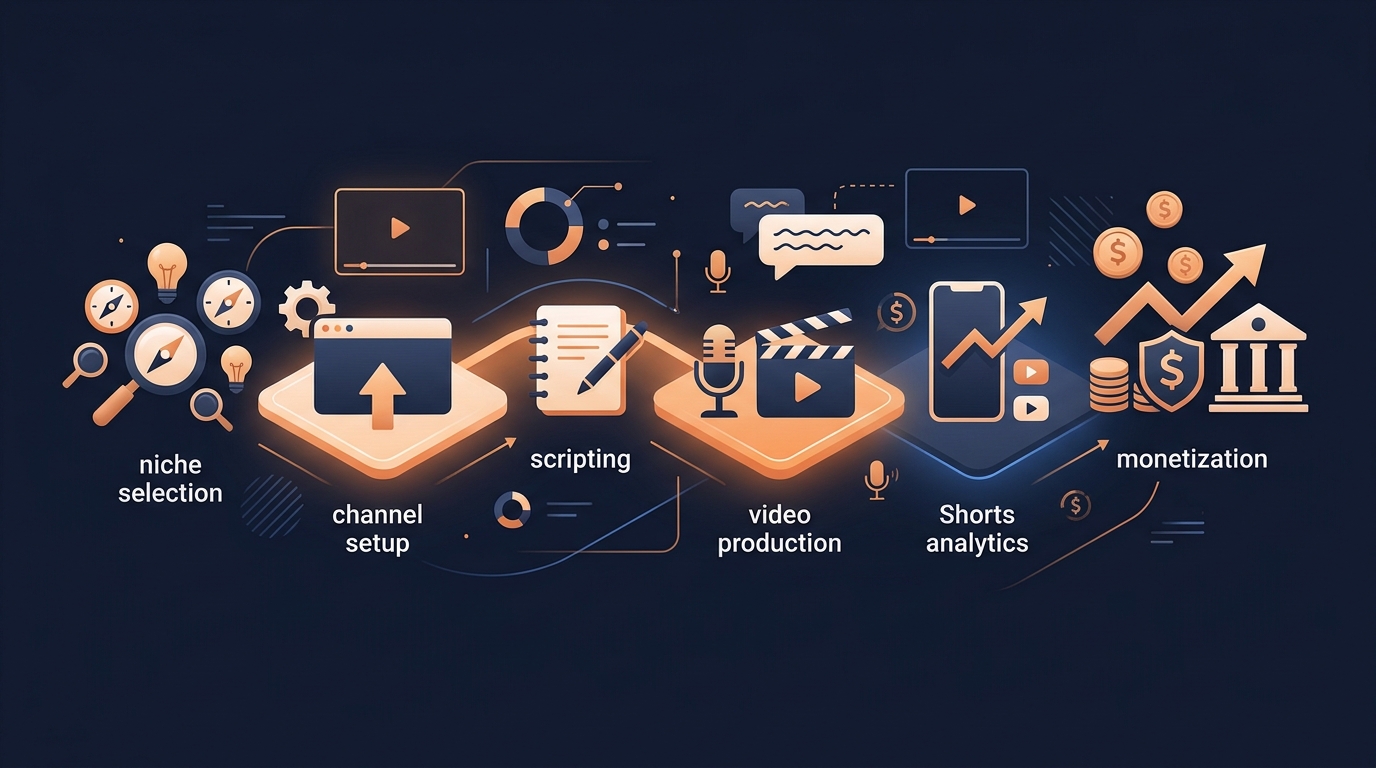
How to Build and Monetise a Faceless YouTube Channel
A practical map for building a faceless YouTube channel—from choosing a niche and making videos to growing on Shorts and creating multiple revenue streams.
How to Build Passive Income With a Faceless YouTube Channel
Learn how to build a faceless YouTube channel with original content, multiple revenue paths, SEO, and policy-aware workflows.