

YouTube Shorts is a good platform for faceless videos when the goal is rapid topic testing, broad discovery, and repeatable production without appearing on camera. Use a three-part decision framework before committing: goal (reach, revenue, or trust), economics (what the reported $0.04-to-$0.40 Shorts RPM can realistically support), and production capacity (whether you can consistently make focused videos with original value). Shorts is less suitable as a stand-alone ad-revenue business unless you have very high view volume or a clear path to long-form content, products, or services.
Key takeaways:
- Faceless YouTube Shorts earn an estimated $0.04 to $0.40 RPM, according to KineClip’s faceless niche RPM data.
- Use a three-part choice framework—goal, economics, and production capacity—to decide between Shorts-first, long-form-first, and a hybrid channel.
- A YouTube Short should make one specific promise in its opening seconds, show evidence or progression that supports that promise, and deliver a complete payoff before the viewer scrolls.
- AI can speed up scripting, narration, captioning, and visual planning, but the creator remains responsible for factual accuracy, originality, rights clearance, and any applicable upload disclosures.
| Option | Primary goal | Revenue expectation | Production format | Best creator situation |
|---|---|---|---|---|
| Shorts-only faceless channel | Discovery and rapid testing | $0.04-$0.40 RPM | 1 vertical idea per video | A creator building reach before monetization |
| Long-form faceless channel | Higher value per viewer | Above the Shorts benchmark in many monetizable niches | 1 deep topic per video | A creator with research-heavy topics and watch-time goals |
| Hybrid Shorts + long-form channel | Discovery plus deeper monetization | $0.04-$0.40 RPM on Shorts; long-form handles deeper conversion | 1 short teaser plus 1 related deep video | A creator who can connect short ideas to a channel library |
Which faceless YouTube format should you choose?
A faceless creator should choose a format by matching the format to the job it must do. Choose a Shorts-first strategy when you need fast feedback on hooks, topics, and visual styles. Choose long-form first when the viewer must understand context, comparisons, or proof before subscribing or taking action. Choose a hybrid channel when a Short can introduce one useful idea and a related long-form video can answer the larger question behind it.
The goal part of the framework is simple: decide what a successful video produces. If success means learning whether viewers care about a topic, Shorts is efficient because each upload can test one promise. If success means explaining a complex process, earning trust, or moving a viewer toward a detailed tutorial, long-form gives more room. If success means both discovery and depth, connect every Short to a closely related library of longer videos instead of treating short and long uploads as separate businesses.
The economics part of the framework prevents a common mistake: confusing reach with revenue. Using the reported $0.04-to-$0.40 RPM range, Shorts ad income may be modest even when a video reaches a large audience. A creator who needs direct ad revenue soon should calculate possible outcomes before building a Shorts-only schedule. A creator who can use Shorts to earn subscribers, research demand, or introduce a deeper offer can assign more value to a view than the immediate RPM alone suggests.
The production-capacity part of the framework asks whether you can sustain quality, not merely volume. A Shorts-first channel needs a reliable stream of narrow ideas, strong opening lines, readable mobile visuals, and quick editorial review. A long-form channel needs stronger research systems and more time per upload. A hybrid channel needs planning discipline: every Short should stand alone, while also pointing naturally toward a deeper related video rather than forcing an unrelated call to action.
Consider a worked example. A faceless software creator wants to validate a channel about productivity workflows but has no audience and can only produce four hours of video work each week. Shorts-first is the sensible starting point: publish several self-contained tips such as “one spreadsheet shortcut that removes a repetitive step,” compare which task categories earn comments and subscribers, and avoid building long tutorials around untested subjects. The goal is learning, not immediate ad income.
Now change the same creator’s goal. Suppose the creator already knows that viewers need help setting up a complete workflow and intends to earn trust through detailed tutorials. A hybrid plan is stronger: publish a Short showing one specific shortcut, then link its natural next question—such as how to build the whole workflow—to a longer guide. The Short earns discovery; the long video carries the explanation. Long-form-first would be appropriate only if the subject cannot be understood responsibly in a brief standalone lesson.
What are the advantages of YouTube Shorts for faceless creators?
YouTube Shorts gives faceless creators a low-friction way to publish one useful, entertaining, or surprising idea without filming themselves. A Short can use narration, captions, stock clips, original graphics, screen recordings, animation, or appropriately reviewed AI-generated visuals. That flexibility makes the format practical for creators who value privacy, cannot record on camera, or have expertise that is easier to demonstrate through screens, diagrams, examples, or a narrated sequence than through a personal appearance.
The main strategic advantage of Shorts is faster learning per production cycle. A creator can test one topic, one hook, one framing choice, and one visual treatment in a single vertical video rather than investing heavily in a broad production. For example, a history channel can test whether viewers respond more to overlooked decisions, disputed events, or individual biographies. A finance education channel can test whether viewers prefer term definitions, common mistakes, or side-by-side comparisons without pretending that one result represents the entire audience.
Shorts also makes broad channel themes easier for unfamiliar viewers to evaluate. A new viewer may not commit to a channel described as “business history” or “software productivity,” but they can quickly understand a specific promise such as “the one change that made this process fail” or “the setting that prevents this common error.” The narrow entry point does not reduce the channel’s authority; it gives the viewer a concrete reason to begin.
Faceless channels can create recognition through repeatable editorial choices rather than an on-camera personality. A consistent narrator, caption treatment, topic structure, visual language, and standard of evidence can become recognizable over time. The downside is that speed does not replace authorship. Every Short still needs an original angle, a source process proportionate to the claim, and a reason the viewer should trust the explanation rather than regard it as generic narration over interchangeable footage.
For opening concepts, use a library of proven video hooks to find structures that suit your niche, then rewrite the wording around your actual insight. A copied hook is weak because it borrows attention without supplying a distinctive promise. A reusable hook structure works when the specific claim, evidence, and payoff belong to the video you are making.
How does YouTube Shorts monetization differ from long-form monetization?
YouTube Shorts monetization differs from long-form monetization because a creator should expect lower direct revenue per thousand views and should treat Shorts as a discovery format first. The reported $0.04 to $0.40 Shorts RPM range means that view counts alone can produce very different outcomes. Long-form videos generally create more room for deeper viewing sessions, detailed explanations, and monetization paths that require more than a few seconds of viewer attention.
A faceless Shorts channel can still support a business, but the model needs a defined next step beyond ad sharing. That next step may be a related long-form video, subscriber growth, a permitted product recommendation, a service, or a digital offer built on genuine expertise. The right path depends on the subject. A story channel may use Shorts to build repeat viewing and a recognizable catalog. An education channel may use a short lesson to introduce a more complete tutorial that answers the viewer’s next question.
A creator should evaluate a Short through more than its direct revenue. Track whether a topic earns subscribers, prompts comments that reveal a follow-up question, or leads viewers to a related deeper video. A Short with fewer views may be strategically more useful than a high-reach upload if it attracts viewers who consistently watch related content. That distinction matters most for faceless channels, where the topic-to-viewer relationship often carries more weight than personality-based loyalty.
For example, a Short that explains one software shortcut can lead to a longer tutorial about the complete workflow. Its direct ad revenue is only one outcome. The same Short may identify a recurring problem, produce comments requesting a walkthrough, and reveal language viewers use to describe that problem. Those signals can shape the next video, its opening promise, and the structure of a channel library more effectively than a single view total can.
For a detailed view of eligibility and revenue mechanics, see YouTube Shorts monetization. For an honest format comparison, review faceless long-form RPM expectations before committing to a Shorts-only publishing plan. Use both resources as planning inputs, not as promises that a particular niche, audience, or publishing cadence will produce the same result.

What RPM can you expect from faceless YouTube Shorts?
YouTube Shorts RPM for faceless content is estimated at $0.04 to $0.40, based on KineClip’s niche-specific faceless YouTube RPM data. RPM means revenue per thousand views after YouTube’s share and other relevant factors. This is a reported estimate, not a platform-wide guarantee, but it is useful for planning because it shows why channels with similar view counts can generate very different direct ad outcomes.
At the low end, $0.04 RPM produces about $40 for 1 million views. At the high end, $0.40 RPM produces about $400 for 1 million views. Those figures are arithmetic illustrations of the reported range, not earnings guarantees. They make the central decision visible: Shorts can create significant exposure, but exposure does not automatically create proportional ad income. A creator relying solely on Shorts ads should know what volume would be required to support the intended monthly revenue.
Niche matters because advertiser value can differ by viewer intent. Audience geography, seasonality, advertiser demand, and the content’s suitability for ads can also affect realized RPM. A creator should not choose a topic solely for a theoretical RPM. A topic that supports repeatable, distinctive Shorts and a useful next step may be more valuable than a supposedly higher-paying topic that repeatedly produces vague, interchangeable videos or attracts viewers who never return.
Set an expectation before publishing and revisit it after gathering enough channel-specific evidence. If the goal is ad income, calculate what the $0.04-to-$0.40 range means for likely monthly views rather than treating one unusually strong upload as a baseline. If the goal is growth, record which topics generate subscribers, repeat views, and movement toward related content. These measures help distinguish a video that merely reached people from one that improved the channel’s underlying business.
A practical tracking sheet can include the Short’s topic, hook, format, view count, subscribers gained, comments requesting related information, and clicks or views on the next related video. The point is not to assign a precise monetary value to every action. The point is to identify whether the channel is building a reusable relationship between a subject, a viewer need, and a next piece of content.
How does audience engagement on Shorts differ from long-form viewing?
YouTube Shorts audience engagement is faster and less forgiving than long-form engagement because a viewer can swipe away in seconds. A faceless Short needs to establish the subject, tension, or benefit immediately, then use narration, captions, and visual changes to keep the viewer oriented. Long-form viewers may tolerate an introduction that sets context; Shorts viewers usually need to understand the point before they decide whether the explanation is worth their attention.
A strong opening does not need to be loud or sensational. It needs to be specific. “This spreadsheet setting can hide the mistake you are looking for” establishes a problem and creates a reason to continue. “Here is a productivity tip” does not establish who the advice is for, what problem it solves, or why it is worth watching. The rest of the Short should then honor the opening by showing the setting, the mistake, and the relevant result without detouring into unrelated information.
Engagement on Shorts is not limited to likes and comments. Look for signals that show whether the premise matched the packaging: viewers who watch through the payoff, viewers who replay a useful moment, comments asking for the next part, and subscribers gained from a specific topic. Compare Shorts with the same content type rather than judging every upload against a single viral outlier. A 20-second tutorial and a 45-second story can require different pacing and create different viewer behavior.
Faceless channels have an extra responsibility to make each video feel authored. Use a clear angle, concrete examples, and visuals that advance the explanation. Random looping stock footage behind generic narration may create initial motion, but it does not necessarily build trust or clarify a claim. When a Short contains a list, reveal each point only when the narration earns it. When it tells a story, change the visual evidence as the setting, decision, or stakes change.
Use Shorts retention strategies after you identify where viewers lose interest. Retention changes work best when the underlying promise is already clear. Faster cuts cannot rescue a video whose opening is vague, and additional captions cannot fix a payoff that does not answer the question the opening created.
What faceless content types work best on YouTube Shorts?
YouTube Shorts works best for faceless content that delivers one complete payoff: a surprising fact with context, a concise tutorial, a before-and-after demonstration, a mini case study, a ranked comparison, a myth correction, or a tightly structured story. Each format gives the viewer a reason to stay because the video answers a defined question rather than trying to compress an entire subject into a sequence of disconnected claims.
A strong faceless Short has a narrow scope. “Three warning signs in a business email” is more watchable than “Everything about business communication.” “Why one historical decision changed an outcome” is more compelling than a rushed summary of a whole era. The smaller promise creates room for evidence, a visual sequence, and a clean ending. It also gives the creator a clear editing rule: remove every sentence and image that does not help prove, explain, or pay off that exact promise.
Tutorials work especially well when the viewer can see a discrete action and result. A software Short can show the starting screen, the one setting to change, and the outcome. A comparison can show the decision criteria before naming the options. A myth-correction Short can state the common belief, explain the missing context, and conclude with the more accurate takeaway. In each case, the structure is useful because the viewer knows what completion looks like.
Stories work when they have a contained turning point rather than a forced cliffhanger. A history, business, or science story can begin with a decision, reveal a constraint, show the consequence, and close with the lesson or unresolved question that is genuinely supported by the material. The video should not withhold its ending simply to manufacture a “part two.” If more context is needed, the Short should still complete one meaningful idea while introducing a related deeper video as an optional next step.
Match visuals to the content. Screen recordings suit software tips. Diagrams suit explainers. Maps and archival-style visuals suit history. Product footage or motion graphics suit comparisons. Original narration matters because it supplies interpretation; visuals should support the claim rather than merely fill the frame. If a visual is decorative rather than evidentiary, replace it with an example, a labeled sequence, or a visual change that helps the viewer understand the point.
Avoid content types that need extensive caveats, highly sensitive advice, or a lengthy setup unless the Short is explicitly an introduction to a longer video. A Short should leave a viewer with a finished idea, not a cliffhanger created only because the explanation did not fit. When a topic has important uncertainty or safety implications, narrow the Short to an uncontroversial, supportable point and reserve the full context for a format that can handle it responsibly.
Which tools and checks do faceless Shorts creators need?
YouTube Shorts can be created with any workflow that handles vertical video, readable captions, voiceover, rights-cleared visuals, and export review. A creator can assemble these tasks manually with separate writing, recording, editing, and captioning tools, or use an AI video platform that combines parts of the workflow. The appropriate choice depends on whether the main constraint is detailed hands-on editing, access to proprietary footage, or the ability to turn researched topics into reviewable drafts consistently.
Manual tools suit creators who already have editing skills, proprietary assets, and a specific visual style they want to control frame by frame. An integrated workflow can suit creators whose bottleneck is moving from a researched topic to a first draft. Neither approach removes the editorial work. Review every script for factual accuracy, confirm that the visual sequence supports the narration, check captions against the intended meaning, and make sure every asset is cleared or otherwise appropriate for use.
AI-assisted creation should be treated as a drafting and production aid, not as an authority on facts or policy. It can help produce a first script, narration, visual plan, or caption draft, but it can also introduce vague wording, unsupported details, mismatched visuals, or an overconfident tone. The creator should compare every factual claim with the source material, remove claims that cannot be supported, and make the final video sound like a considered editorial decision rather than an automated summary.
Creators should also review YouTube’s current upload requirements and disclosure options directly when a video includes realistic altered or synthetic material that may require transparency. Platform rules can change, and a blog post or tool interface is not a substitute for reviewing the requirements in effect when the video is uploaded. The practical habit is to keep a simple production record: what source material informed the script, what assets were used, what AI contributed, and what disclosure decision was made.
A pre-export checklist makes this process repeatable. Check that the first line states the specific promise; that every number, date, and quoted statement has been verified; that captions are readable on a phone-sized screen; that music does not overpower narration; that visuals match the spoken claim; and that the ending provides a completed takeaway. This is more useful than adding automation alone because it catches the failures that viewers and platform reviewers can actually see.

How do YouTube Shorts contribute to faceless channel growth?
YouTube Shorts contributes to faceless channel growth by introducing a channel’s topics to viewers who would not commit to a longer video first. A Short functions as compact proof of value: a viewer learns something, enjoys a story, or solves a small problem, then decides whether the channel deserves another view. The strongest growth outcome is not one isolated spike; it is a repeatable match between a defined audience need, a topic pattern, and the channel’s editorial approach.
Build that match with topic clusters. If one Short explains a common mistake, publish a follow-up that shows the fix. If a story earns comments, make the next installment self-contained while using the same theme. If viewers respond to a comparison, create another comparison using the same decision framework but a different problem. Topic clusters give viewers a recognizable reason to return without requiring every upload to be a numbered series or a continuation that excludes new viewers.
Use each Short to make a deliberate next step available. That next step may be a related long-form video, a playlist, or another Short that answers the obvious follow-up question. The connection must be genuine. A viewer who watched a 30-second software shortcut is more likely to watch a deeper tutorial on that same task than an unrelated channel upload. The strongest bridge repeats the viewer’s actual interest instead of switching subjects after attention has been earned.
Creators should separate view growth from business growth. High-reach entertainment Shorts can build a large audience, while educational Shorts can attract fewer but more commercially relevant viewers. Neither outcome is automatically better. Decide which audience the channel needs before optimizing titles, hooks, visual style, and calls to action. A creator seeking broad reach may prioritize accessible stories; a creator seeking trust for a complex service may prioritize clear demonstrations of expertise.
A useful monthly review compares topic clusters rather than individual uploads. Ask which cluster creates repeat viewers, which earns the most relevant comments, which attracts subscribers, and which naturally leads viewers to another video. This approach reduces the temptation to chase a viral format that is disconnected from the channel’s purpose. It also gives faceless creators a durable identity rooted in what they explain, show, or investigate rather than in a constantly changing set of trends.
How can AI improve the faceless Shorts production workflow?
AI can improve a faceless Shorts workflow by reducing the time required to move from a researched topic to a draft script, voiceover, visual sequence, captions, and export-ready video. AI is most useful for repetitive production tasks, such as creating an initial storyboard, generating caption timing, or proposing visual treatments. The creator remains responsible for the angle, factual review, source quality, rights clearance, and final edit because those are the decisions that determine whether the video is useful and trustworthy.
A reliable workflow starts with a narrow brief. Define the audience, the single takeaway, the evidence that must appear, the desired tone, the visual constraints, and the action the viewer should be able to take after watching. Then inspect the proposed hook against the actual promise. If the hook says the video will reveal a mistake, the body must show the mistake and explain why it matters. If the hook promises a comparison, the criteria must be clear before the conclusion appears.
Next, review generated narration line by line. Replace vague phrases such as “this changes everything” with the precise effect the viewer can verify. Remove any detail that is not supported by the research. Check whether the sequence has a beginning, progression, and payoff rather than a list of statements. Finally, preview the video on a phone-sized screen to make sure captions remain readable, important visual details are not obscured, and each image, clip, or screen recording supports the spoken claim.
GoFaceless, our own product, is one option for creators who want to run this workflow in one pass: it can turn a topic, brief, or reference into a short-form draft with an AI script, voiceover, visuals, captions, music, preview, and export controls. Separate tools may be a better fit when a creator needs granular control over existing footage or an advanced manual edit. An integrated platform is most useful when consistent production and reviewable first drafts are the main constraints.
AI-generated videos can be monetizable when they are original, useful, and policy-compliant, but automation is not a substitute for editorial standards. Check YouTube’s inauthentic content policy before scaling a template-driven channel, and review applicable disclosure requirements during upload. The safer operating principle is simple: use AI to accelerate production mechanics, while retaining human responsibility for the claim, the evidence, the creative judgment, and the final decision to publish.
Ready to test a faceless Shorts workflow?
Start with three topic ideas, give each one a distinct hook and complete payoff, and compare audience response before scaling production. Create a GoFaceless account to turn a topic or brief into a reviewable short-form draft.
Sources & further reading
Keep reading

How the YouTube Shorts Algorithm Works
Learn how YouTube Shorts recommendations use viewer behavior, format eligibility, retention, AI disclosures, and practical editing tests.

How to Start a Faceless YouTube Channel in 2026
Start a faceless YouTube channel with a focused niche, original format, 30-day testing plan, and YouTube-compliant AI workflow.
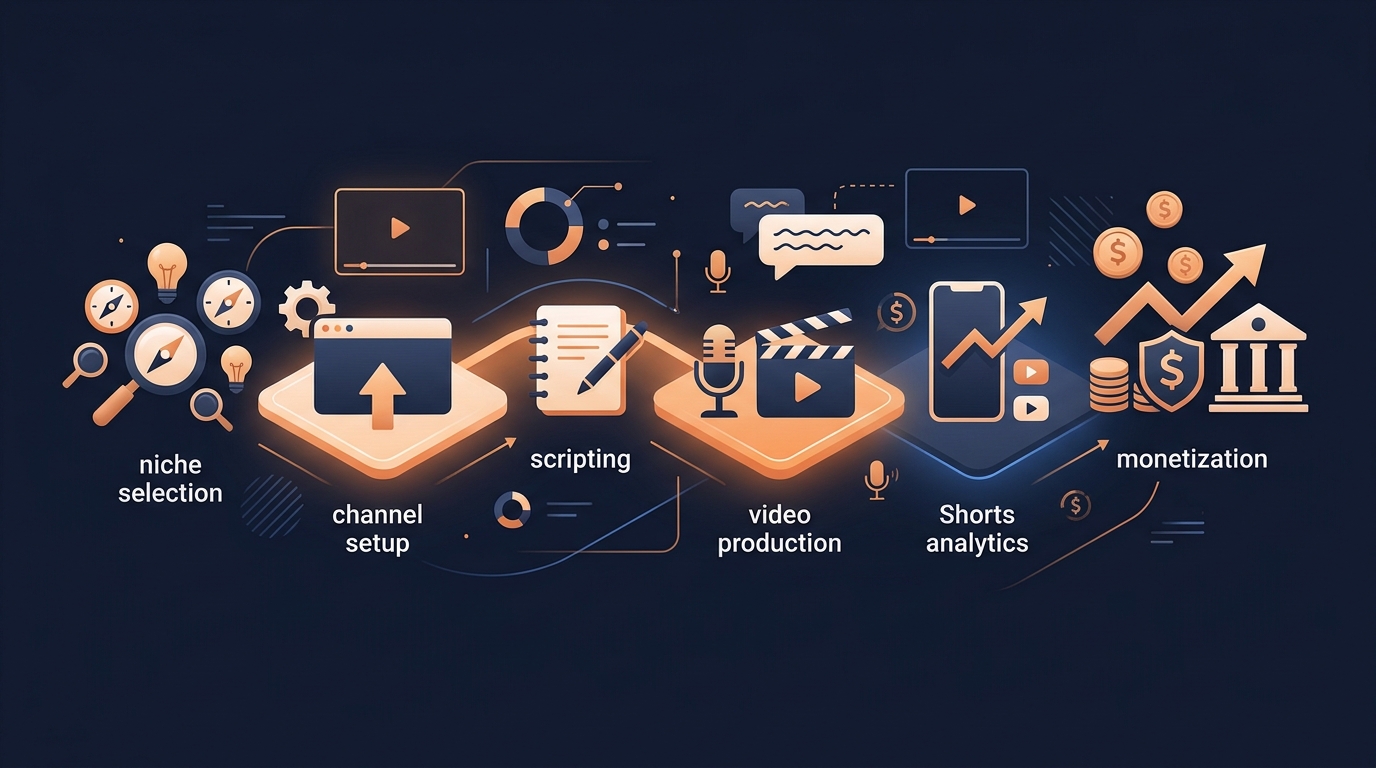
How to Build and Monetise a Faceless YouTube Channel
A practical map for building a faceless YouTube channel—from choosing a niche and making videos to growing on Shorts and creating multiple revenue streams.