
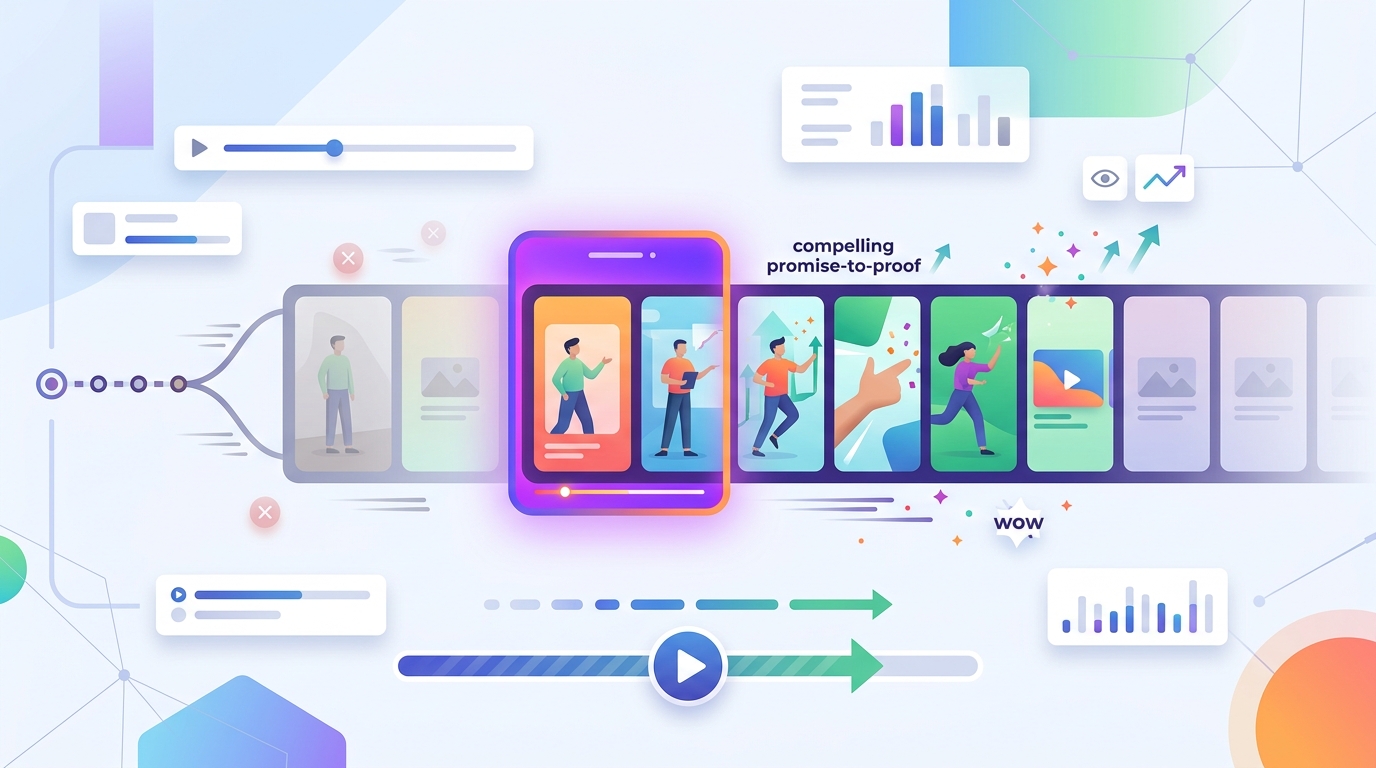
Use this hook template: “If [specific viewer] is struggling with [specific problem], show [visible proof], then promise [one immediate result].” For example: “If your Shorts lose viewers before the tip starts, watch this before-and-after opening—I’ll show you the replacement line.” The next beat must show that replacement line, not an introduction.
Write a short-video hook by naming a specific viewer problem or curiosity gap, showing proof or a visual consequence immediately, and promising one clear payoff that the next beat delivers. Build three variations, adapt the opening to Shorts, TikTok, or Reels, then keep the version that holds the most viewers through its opening seconds.
Key takeaways:
- TikTok viewers make an average keep-or-skip decision in 1.7 seconds, compared with 2.1 seconds for Instagram Reels and 2.5 seconds for YouTube Shorts, according to DDAverse.
- Question-style openings produced a 22% lift in retention through the first 5 seconds in Reviral’s 2026 short-form data report.
- 86.6% of high-performing short-form videos use word-level animated captions, according to Reviral’s 2026 report.
- For YouTube Shorts, aim to retain 70–90% of viewers in the opening seconds, as recommended by vidIQ.
The DDAverse and Reviral figures above are useful directional benchmarks, not universal platform rules. Before using those figures as planning targets, review the linked reports for their definitions of “high-performing,” their video sample, and their methodology; those details determine how far the findings can be generalised to a particular account, niche, audience, or video length. The most reliable decision for an individual creator remains a controlled comparison against that creator’s own retention baseline.
Prerequisites: one clear video topic, one audience problem or desired outcome, and access to each platform’s retention analytics.
Realistic total time: allow 30–45 minutes to draft three hook variants, create opening visuals, publish, and log the first retention result.
Why are the first few seconds critical for a video hook?
The first few seconds of a short-form video determine whether a viewer understands the subject, sees a reason to continue, and chooses not to scroll. DDAverse’s 2026 hook-writing guide reports average keep-or-skip decision times of 1.7 seconds for TikTok, 2.1 seconds for Instagram Reels, and 2.5 seconds for YouTube Shorts. Treat the reported timings as a prompt to make the opening legible immediately, rather than as precision measurements that apply identically to every viewer.
| Average viewer decision time by short-form platform | |
|---|---|
| TikTok seconds | 1.7 |
| Instagram Reels seconds | 2.1 |
| YouTube Shorts seconds | 2.5 |
A video hook has three jobs before a creator’s greeting, logo animation, or broad setup can consume attention:
- Identify relevance: tell the intended viewer what problem, result, or story is on screen.
- Create tension: show the cost of the problem, a surprising contrast, or an unanswered practical question.
- Set up a near-term payoff: make clear what the next beat will prove, explain, or reveal.
Consider the difference between two openings for a video about robotic AI voiceovers:
- Weak opening: “Hey everyone, today I’m going to share some tips for making your AI voiceovers better.”
- Hook opening: “This sentence sounds robotic because every phrase is the same length—listen to the rewrite.”
The second opening names the subject (AI voiceovers), identifies a concrete fault (same-length phrases), and creates proof the viewer can hear immediately. The hook does not need to claim a dramatic transformation. It only needs to make a specific, honest next moment worth watching.
How do you decide the exact outcome before writing a hook?
Action: State the useful, surprising, or emotionally satisfying outcome in a single sentence before writing a hook.
What it requires: Define one audience, one problem, and one payoff. For example: “New creators can make voiceovers sound less robotic by changing the script rhythm.”
How to tell it worked: A viewer can describe what they will gain without needing the title, caption, or later context.
Turn the defined outcome into a visible opening. Instead of saying, “Today I’m sharing voiceover tips,” show a bad-sounding script beside an improved version and say, “This one writing change makes AI voiceovers sound human.” The first frame should make the claim understandable even with sound off.
A practical outcome sentence can be built with this decision chain:
- Audience: Who has the problem? Example: new creators using generated voiceovers.
- Observed friction: What is going wrong? Example: the delivery feels flat and synthetic.
- Mechanism: What will the video change? Example: sentence rhythm and punctuation.
- Payoff: What can the viewer do after watching? Example: rewrite one line so the voice has more natural pauses.
That chain produces a hook such as: “If your AI voiceover sounds flat, stop writing every sentence at the same length—here’s the before-and-after.” The opening is stronger than “AI voiceover tips” because the viewer can recognise the failure, anticipate the demonstration, and judge whether the topic is relevant before investing more time.
TikTok generally rewards the fastest, most native-feeling entry: start inside the moment, use direct second-person language, and avoid scene-setting. Reels can support a slightly more polished visual reveal, but the claim still needs to arrive immediately. Shorts can use a more explicit promise because viewers often arrive through recommendations and search-led topics; put the exact result early rather than relying on a vague tease.
What makes a question-style hook effective?
A question-style video hook works when the question names a problem the intended viewer already recognises and makes the answer feel immediately useful. Reviral’s 2026 short-form data report says question openings produced a 22% lift in retention through the first five seconds. Use that finding as a hypothesis to test, because the linked report’s sample and definitions should be checked before treating the percentage as a universal expected lift.
The strongest question is narrow enough that the right viewer answers “yes” internally, not broad enough to invite an indifferent scroll. A useful question carries an implied consequence: the viewer is not merely curious about the answer; the answer could improve, prevent, diagnose, or explain something that matters to the viewer.
How do you turn a viewer’s exact friction into a hook question?
Action: Write three questions using a real frustration, mistake, or desired result from your topic.
What it requires: Use concrete nouns and consequences. Avoid generic prompts such as “Want to grow?” or “Did you know this?”
How to tell it worked: The question identifies who it is for and what is at stake in one spoken sentence.
Use one of these frameworks:
- Mistake: “Why do your Shorts lose viewers before the tip even starts?”
- Diagnosis: “Are your captions making viewers scroll instead of watch?”
- Contrarian result: “What if your best hook is not your first sentence?”
- Specific outcome: “How do you make a faceless finance video feel credible in five seconds?”
A question is not automatically a hook. “Do you like productivity?” is too broad because neither the audience nor the payoff is clear. Improve the question by adding a constraint and consequence: “Why does your to-do list make you less productive by noon?” The improved productivity question implies a familiar symptom, a time boundary, and an explanation that may change the viewer’s behaviour.
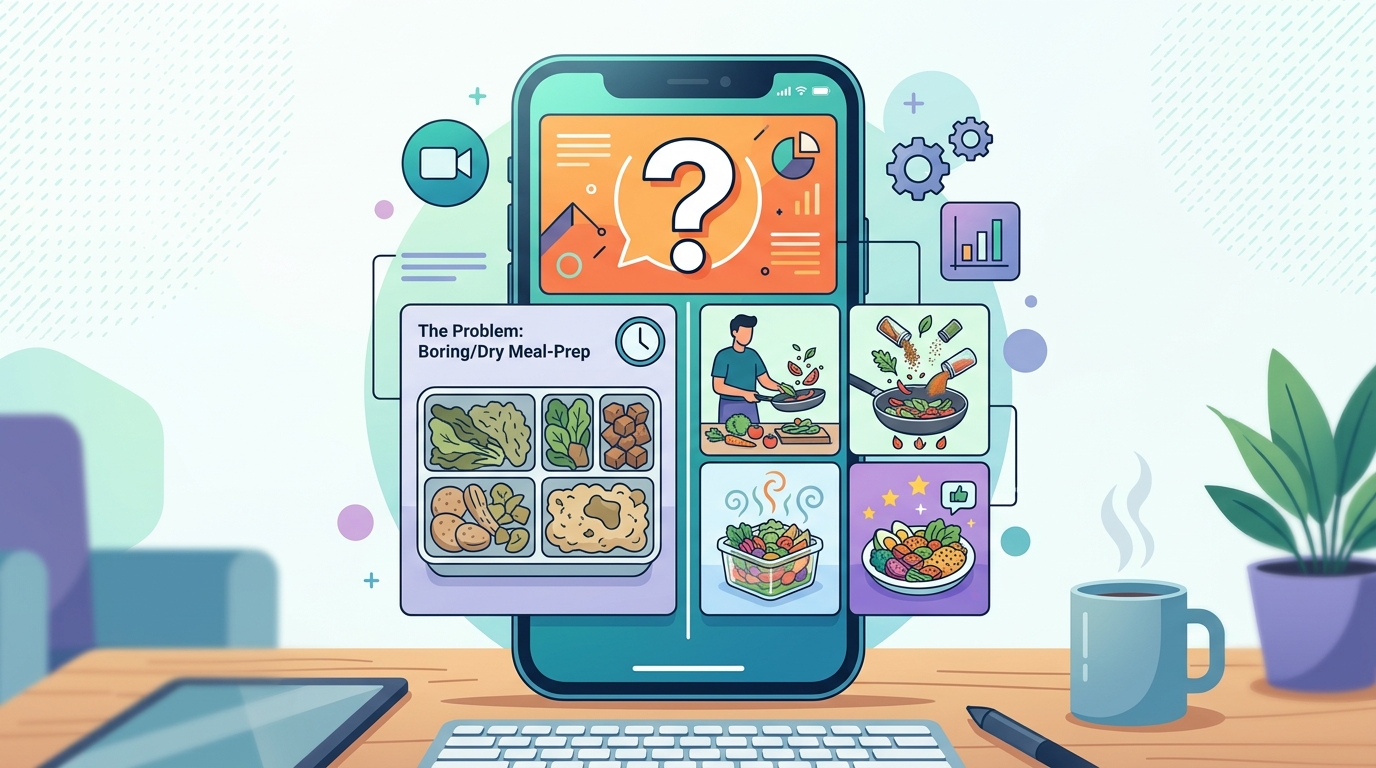
Here is a worked example for a creator teaching meal-prep videos.
| Hook version | What the viewer can infer | Main weakness or strength |
|---|---|---|
| “Do you want to meal prep?” | The topic is meal prep. | Too broad; no tension, audience detail, or promised result. |
| “Why does your meal prep go bad by Wednesday?” | The topic is food storage and a midweek failure. | Strong diagnosis, but the next beat must show the cause quickly. |
| “Why does chicken meal prep go dry by Wednesday? Change this cooling step.” | The topic, specific failure, and likely fix are clear. | Strongest option when the video can demonstrate the cooling step immediately. |
For the strongest meal-prep question, the first three beats might be:
- 0:00–0:01: Show dry chicken in a container with the caption “Dry by Wednesday?”
- 0:01–0:03: Say, “Are you sealing hot chicken straight into the container?” while showing the sealed container.
- 0:03–0:05: Show the alternative cooling setup and say, “Let steam escape first, then portion it.”
The question earns attention because the proof starts before the viewer has to wait through a list of tips. A question that survives beyond the opening must create a precise open loop, not postpone basic context. If a viewer asks, “What is this video about?” after the first two seconds, the question is still too abstract.
How do animated captions enhance video hooks?
Animated captions enhance a video hook by turning the first spoken claim into an additional visual event, making the message easier to follow when viewers watch without sound. In Reviral’s 2026 data report, 86.6% of high-performing videos used word-level animated captions. The reported association does not prove captions caused performance, and the report’s methodology should be reviewed before applying the figure as a rule; topic strength, editing, distribution, and creator audience can also affect results.
Captions should reinforce the key words in the hook rather than reproduce every spoken word with the same visual weight. A caption system is doing its job when it directs the eye toward the promise, the problem, or the proof—not when it adds movement simply because movement is available.
How do you choose which hook words deserve caption animation?
Action: Choose two to five high-value words in the first sentence and give those words motion, scale, colour contrast, or a timed reveal.
What it requires: A readable caption style, safe placement away from platform controls, and an opening visual that does not compete with the text.
How to tell it worked: A muted viewer can understand the hook’s claim from the first frame and its caption emphasis.
For the hook “Your first sentence is killing your Shorts,” make first sentence appear first, then land killing on the beat or visual change. Do not animate every word with a different effect. Constant movement becomes visual noise and weakens the central promise.
Use a caption hierarchy rather than a uniform transcript:
| Hook component | Caption treatment | Why the treatment helps |
|---|---|---|
| Viewer problem | Largest or highest-contrast phrase | Helps the relevant viewer self-identify quickly. |
| Consequence | Timed emphasis, scale change, or beat-synced entrance | Makes the cost of ignoring the problem feel immediate. |
| Specific fix or result | Stable, readable reveal | Lets the viewer understand the promise without chasing motion. |
| Supporting words | Smaller, consistent styling | Preserves readability without competing with the key claim. |
For example, a hook about weak product demonstrations could be captioned in three intentional layers:
- Spoken line: “Your product video is losing buyers before the product appears.”
- First caption emphasis: losing buyers appears over a blank or overly slow opening frame.
- Second caption emphasis: before the product appears lands as the actual product enters frame.
- Next beat: show the corrected version, where the product is visible immediately.
That sequence uses captions to clarify causality. The text is not decoration; the phrase “before the product appears” tells viewers exactly what the video will correct.
Match caption pace to the platform. On TikTok, fast word-level emphasis can support conversational delivery and cuts. On Reels, use clean contrast and allow product shots or demonstrations to remain legible. On Shorts, captions should clarify the topic directly, especially for educational or search-adjacent videos. After the hook, use pattern breaks that reset attention rather than relying on captions alone to carry the full video.
How can a video hook deliver on its promise?
A video hook delivers on its promise when the first substantive beat gives the viewer proof, an answer, or a clear route to the answer immediately after the opening claim. A hook that promises “three edits that improve retention” must begin the first edit within the next beat, not spend time on creator introductions. Clear delivery protects retention because viewers can verify that the video is about what the hook claimed.
The promise-to-proof sequence is especially important for short-form video because an opening claim creates a small contract with the viewer. The more specific the opening claim, the faster the creator must provide evidence. A broad claim can be followed by a broad explanation; a claim such as “replace this exact sentence” requires the sentence to appear on screen almost immediately.
How do you sequence a hook, proof, and first lesson without delaying value?
Action: Write the hook, proof, and first value point as three consecutive lines before filming or generating visuals.
What it requires: One claim you can demonstrate, an appropriate visual, and an answer that does not depend on a later reveal for basic usefulness.
How to tell it worked: If the hook is removed, the next line still begins the promised lesson; if the proof is removed, the hook still accurately describes the lesson.
Use this sequence:
- Promise: “This hook format earned my educational Shorts more early attention.”
- Proof or demonstration: Show the before-and-after opening line or the retention graph segment you are discussing.
- First value point: “Lead with the mistake, then name the fix in the same sentence.”
Avoid bait-and-switch structures such as promising a template but giving only general encouragement. Also avoid a payoff that is technically related but weaker than the opening claim. If the hook says “free script structure,” show the structure on screen. If the hook says “the reason viewers leave,” explain a real reason before asking viewers to comment.
A concrete worked sequence makes the difference clearer. Imagine a 25-second Short teaching a creator how to improve a weak finance-video opening.
| Time | Weak version | Promise-to-proof version |
|---|---|---|
| 0:00–0:02 | “Today, I’ll explain how to make finance videos more credible.” | “Your finance video loses trust when the first claim has no evidence.” |
| 0:02–0:04 | Creator explains why credibility matters. | Split-screen: unsupported claim on the left, visible source or calculation on the right. |
| 0:04–0:07 | Creator says there are three tips. | “Put the number, source label, or calculation beside the claim in the first frame.” |
| 0:07 onward | First tip finally begins. | The video can move to the second credibility technique. |
The improved version does not depend on a sensational promise. The improved finance-video hook establishes the viewer’s problem, visually demonstrates the distinction between unsupported and supported claims, and gives a usable first instruction within about seven seconds. The later points become additive rather than overdue.
A simple storyboard keeps the promise visible across production. For faceless formats, the opening visual might be a highlighted script, split-screen comparison, screen recording, or animated object sequence. The same principle applies whether you edit manually or use an AI workflow: the first visual must verify the opening line.
What viewer retention rates should you aim for in a video hook?
For YouTube Shorts, creators should aim for 70–90% viewer retention in the opening seconds, according to vidIQ’s Shorts hook guidance. Treat that range as a diagnostic target for the hook rather than a guarantee of reach: a short can have a strong opening and still lose viewers later if the pacing, proof, or payoff fails. The useful comparison is between hook variants and a creator’s own recent videos with similar length, subject, and audience intent.
A retention percentage is only meaningful alongside the conditions that produced it. A 20-second tutorial, a 50-second story, and a controversial reaction video can create different viewing behaviour even when the first line is equally clear. Log the opening conditions so that a promising result can be repeated and a weak result can be diagnosed.
How do you test one hook variable without confusing the result?
Action: Publish or prepare three versions of the same short with different hook lines, not different topics and edits.
What it requires: Keep the core value, length, visual style, and target audience consistent. Change one variable: question versus statement, proof-first versus claim-first, or broad versus specific wording.
How to tell it worked: One opening retains a visibly larger share of viewers in the early retention curve while the rest of the video remains comparable.
Use a simple test log: hook text, first-frame visual, caption treatment, platform, and early retention result. That record prevents a common error: crediting a hook when the improvement actually came from a stronger topic or more compelling opening visual.
A controlled three-variant test might look like this:
| Variant | Variable being tested | Keep unchanged | What to inspect |
|---|---|---|---|
| A | Question opening: “Why do viewers leave before your tip starts?” | Same lesson, same b-roll, same length, same caption style | Early retention curve and comments that show recognition of the problem. |
| B | Statement opening: “Viewers leave before your tip starts because the payoff arrives too late.” | Same lesson, same b-roll, same length, same caption style | Whether direct diagnosis outperforms the question for the audience. |
| C | Proof-first opening: show the retention dip, then say the diagnosis | Same lesson, same b-roll after the first proof frame, same length | Whether a visible consequence earns more early attention than either line alone. |
Do not conclude that Variant C “won” if Variant C also used a more dramatic visual, a shorter runtime, or a more compelling topic. The purpose of the test is not to manufacture certainty from a small number of posts. The purpose of the test is to build account-specific evidence about whether the audience responds more strongly to questions, direct claims, or immediate proof.
On Shorts, inspect the opening retention curve and then use broader YouTube Shorts retention benchmarks to interpret the result in context. On TikTok and Reels, use the same testing discipline without assuming YouTube’s 70–90% target applies directly. Each feed has different viewer intent and measurement surfaces, so improve against your own baseline.
How does YouTube’s algorithm affect a Shorts hook strategy?
YouTube Shorts hook strategy should prioritise the opening that earns engaged viewing from the right audience, not the loudest or most misleading claim. YouTube Help defines “Engaged views” as “the number of times viewers stayed to watch past the initial seconds of a Short,” in its official Shorts analytics documentation. The official definition explains why a Shorts opening must accurately signal the topic and make the next moment worth watching.
The quoted definition does not mean a creator should optimise only for an opening metric. A misleading hook may get a viewer past the initial seconds, but the mismatch can still damage the rest of the viewing experience. A useful Shorts hook aligns the spoken line, first-frame image, title, and first proof point around the same topic.
How do you make a Shorts hook signal the real lesson immediately?
Action: Put the subject, result, or mistake in the spoken line and first visual rather than using a generic viral phrase.
What it requires: A specific topic statement, a first-frame asset that supports it, and a title or caption that does not contradict the opening.
How to tell it worked: Viewers who stay through the hook encounter the exact lesson, story, or demonstration the opening promised.
For a YouTube Short, “The first line in this script loses viewers—replace it with this” is stronger than “You need to see this.” The first version gives YouTube and viewers a coherent topic signal; the second forces curiosity without establishing relevance. Learn more about how recommendations and viewer signals interact in this guide to the YouTube Shorts algorithm.
Here is a practical topic-alignment check before publishing a Short:
- Spoken hook: Does the first sentence name the actual problem or result?
- First visual: Does the first frame show the script line, object, result, or evidence mentioned in the sentence?
- First value beat: Does the video begin the explanation or demonstration immediately after the hook?
- Title and caption: Do the supporting metadata use the same topic language rather than a disconnected trend phrase?
- Ending: Does the conclusion fulfil the original promise rather than pivot to a different lesson?
For example, a Short titled “How to write a hook for a faceless history Short” can open with: “Your history Short starts too far before the event—open at the moment everything changes.” The first frame can show a timeline with the slow opening crossed out and the pivotal event highlighted. The next beat can provide the exact rewrite: “Replace ‘In 1912, tensions had been rising’ with ‘At 11:40 p.m., the ship received the warning it could not ignore.’” The hook, visual proof, and lesson all refer to the same storytelling decision.
Use search-friendly clarity when the topic solves a known problem, such as “How to write a hook for a faceless history Short.” Use curiosity only when the visual proof arrives immediately. The right strategy is not to maximise surprise at any cost; it is to create an accurate expectation, satisfy it quickly, and earn the next few seconds of attention.
What should you do after writing three hook variants?
After writing three hook variants, choose the clearest promise, pair the chosen line with a first-frame visual that proves the claim, and log the opening retention result before changing the rest of the video. The final production check is simple: a muted viewer should understand the problem, a sound-on viewer should hear the promised outcome, and both viewers should receive the first proof or instruction in the next beat.
Before publishing, run this final hook checklist:
- Does the first sentence identify a specific viewer, problem, or outcome?
- Does the first frame show evidence, contrast, or a consequence connected to that sentence?
- Do the captions emphasise only the few words carrying the promise?
- Does the next beat deliver proof or a first usable instruction?
- Does the video avoid an intro, greeting, or unrelated setup before the promised value?
- Is the platform-specific version still honest about what the full video delivers?
- Have you recorded the hook text and opening visual so that the retention result can inform the next test?
For fresh prompts, use the free hook library to explore opening structures by topic. GoFaceless, our product, is one workflow option for turning a selected topic and hook into a faceless short with script, voiceover, visuals, captions, music, and export controls; compare its workflow with the production process that fits your team.
Ready to test your strongest hook? Start creating a video.
Sources & further reading
Keep reading
How to Improve AI Video Completion Rates
Improve AI video completion rates with clearer briefs, defined review gates, rework tracking, and a completion-first production workflow.
The Growth of AI-Generated Shorts: What Creators Need to Know
Learn what the available 2026 AI Shorts data says about creator adoption, render time, originality, disclosure, and testing workflows.

AI Content Disclosure Rules for Video Creators
Learn when video creators must disclose realistic AI content under the EU AI Act, TikTok policy, and IAB advertising guidance.