

DTC brands are increasing AI video production because short-form demand now requires a faster, more repeatable content operation than traditional shoots alone can provide. AI lets brand teams create more concepts, captions, visual variants, and platform-ready edits while reserving human time for product positioning, creative judgment, and performance decisions.
Key takeaways:
- DTC brands produce 47 short-form videos per month, according to Wayout’s 2026 DTC content-spend report, up from 28 per month in 2024.
- The increase from 28 monthly short-form videos in 2024 to 47 in 2026 is a 19-video monthly rise in required output.
- 62% of DTC brands use AI for captioning and b-roll synthesis, two repeatable production tasks that can otherwise slow a short-form workflow.
- AI video production changes the DTC production model from making a few campaign assets to maintaining a testable library of channel-native video variants.
What does the available 2026 DTC evidence actually measure?
The available 2026 DTC evidence measures two operational signals: monthly short-form output and adoption of AI for specific production tasks. It does not measure return on ad spend, conversion lift, profit, creative quality, or whether AI alone caused the output increase. That distinction matters: the evidence supports a shift in content operations, not a universal performance claim for AI video.
Method: This analysis is based on two quantitative findings published in Wayout’s 2026 report, which Wayout identifies as the “DTC Content Spend 2026” report. The supplied evidence does not state a sample size, respondent mix, fieldwork period, methodology, channel-level budget split, or definitions for “short-form video.” Those omissions limit how far the data can be generalized.
Findings:
| DTC content-production measure | Figure | Strategic reading |
|---|---|---|
| Short-form videos per month in 2024 | 28 | A lower baseline for ongoing content volume |
| Short-form videos per month in 2026 | 47 | A larger always-on production requirement |
| Brands using AI for captioning and b-roll synthesis | 62% | AI is being used inside established production workflows |
The core finding is not that every DTC brand should automate every asset. The core finding is that DTC teams now need enough production capacity to support frequent publishing, creative testing, paid-social iterations, and organic channel activity at the same time.
What benefits do DTC brands see with AI video?
DTC brands benefit from AI video when AI removes repeatable production work and makes more creative variations practical. The clearest evidence is operational: DTC brands now produce 47 short-form videos each month, up from 28 in 2024. At that volume, the value is not simply faster editing; it is the ability to sustain a systematic testing and publishing cadence without treating every asset as a standalone production.
The practical benefits fall into four areas.
More testable creative without multiplying shoots
A DTC team can turn one approved product angle into several executions: different hooks, benefit order, objections, voiceover pacing, product demonstrations, caption treatments, and calls to action. The goal is not to flood a feed with near-duplicates. The goal is to learn which message earns attention from a specific audience on a specific channel.
For example, a skincare brand could use the same core claim to test a routine-led opener, a problem-led opener, and a customer-question opener. Each version should preserve approved claims and visual guidelines while changing one meaningful creative variable.
Faster channel adaptation
TikTok, Instagram Reels, and YouTube Shorts reward content that feels native to the viewing environment. AI-assisted workflows make it easier to reframe an approved concept for vertical formats, shorten an introduction, adjust caption density, or create a fresh cut when an offer changes.
Less friction in repeatable tasks
The adoption data is specific: 62% of brands use AI for captioning and b-roll synthesis. Those tasks often sit between strategy and publishing, where small delays can cause a content calendar to slip. Automating a first draft does not remove review; it gives editors and brand managers a faster starting point.
Better use of specialist time
In-house creative leads can spend more time on the decisions that require brand context: claim substantiation, product truth, visual distinctiveness, creator direction, and the interpretation of performance results. Agencies can spend more time on campaign concepts and high-craft executions instead of routine asset resizing and caption passes.

How has AI changed video production for brands?
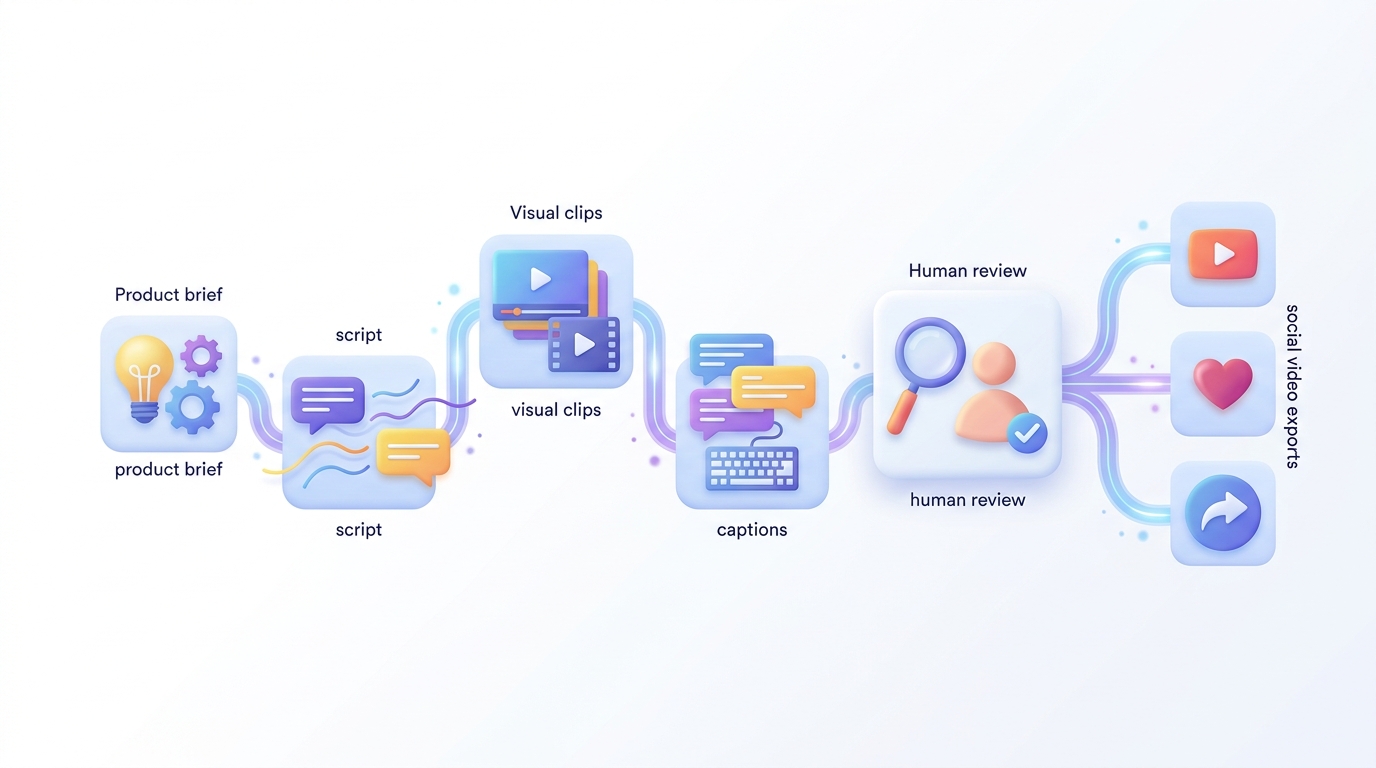
AI has changed DTC video production from a linear, campaign-led workflow into a modular content system. A brand can now begin with a product brief, develop multiple hooks, create first-pass scripts and visuals, add captions, and route selected versions through human review. The shift is most useful for short-form assets because DTC teams are producing 47 videos per month on average in the reported 2026 data, not a handful of isolated hero films.
Traditional workflows often organize work around a shoot date: brief, concept, production, edit, approvals, and delivery. That process still fits flagship launches and assets that require a founder, product macro photography, professional talent, or controlled demonstrations. AI introduces another lane: ongoing production of lower-risk, repeatable, and rapidly testable content.
A workable operating model separates work into three layers.
Brand system: Maintain approved product claims, prohibited language, visual rules, voice guidelines, customer objections, and legal review requirements in one reference document.
Creative system: Build reusable formats such as myth-versus-fact, problem-solution, comparison, how-to, FAQ, gift guide, and product-use scenarios. Strong formats make iteration easier without making content feel generic.
Learning system: Record the hook, audience, channel, offer, length, and outcome for every published variation. A team cannot learn from volume if it does not know what changed between versions.
AI also changes the role of editors. Editors increasingly become quality controllers and creative operators: checking product accuracy, removing visual mismatches, shaping pacing, and deciding whether a concept is worth another iteration. Teams moving to this model can use a human-editing-to-AI production transition plan to define which decisions remain human-owned.
For short-form performance, the opening still deserves deliberate work. A structured source of tested opening patterns, such as a free library of 3,500+ video hooks, can help teams generate angles before they create variants.
What are the cost implications for DTC brands using AI?
The cost implication of AI video for DTC brands is a shift from buying isolated finished assets toward funding an ongoing content capability. AI can reduce the labor attached to first drafts, captioning, b-roll assembly, and format adaptation, but it does not eliminate the cost of strategy, product accuracy, creative direction, approvals, analytics, or rights management. A lower production cost only helps when the additional output has a clear testing or distribution purpose.
Brand managers should avoid comparing AI with a full production shoot as though they are interchangeable purchases. They solve different jobs.
| Production need | Better planning approach |
|---|---|
| A rapid paid-social variation | Budget for a short approval loop, an AI-assisted draft, and a defined performance test |
| An always-on organic series | Budget for format development, recurring inputs, review, and a publishing calendar |
| A product launch film | Budget for human creative direction, product capture, talent or creator work, and higher-fidelity post-production |
| A seasonal offer refresh | Budget for prompt adaptation, approved copy updates, captions, and channel-specific versions |
The financial advantage appears when one approved concept can support several useful iterations. If a team creates five nearly identical videos that do not test a message, audience, or placement, AI only makes waste faster. If the team creates five purposeful versions that isolate a hook or objection, AI can make a normal testing discipline easier to maintain.
In-house teams should prioritize a reliable brief-to-review workflow before buying more tools. Agencies should prioritize concept development, production systems, and creative governance that a brand team can use between larger campaigns. Both should define the review threshold: which assets can be reviewed by a channel manager, and which require legal, product, or senior-brand approval.
When evaluating software, use a practical AI video tool checklist that covers review controls, output formats, caption editing, asset control, and export needs rather than choosing on generation speed alone.
Are DTC brands fully replacing traditional video production?
DTC brands are not fully replacing traditional video production with AI because AI-assisted short-form content and high-touch brand production serve different strategic purposes. The reported adoption pattern supports a blended model: 62% of brands use AI for captioning and b-roll synthesis, which suggests AI is often handling components of a workflow rather than replacing every creative role. Traditional production remains important when authenticity, physical product proof, creator presence, or premium visual control is central to the message.
A useful division of labor looks like this.
Use AI-assisted production for repeatable output
Use AI for FAQ videos, educational explainers, offer updates, organic series, comparison frameworks, routine content, draft captions, and visual first passes. These assets benefit from speed and from the ability to create multiple versions without reopening a full shoot.
Use traditional production for irreplaceable proof
Use conventional shoots for product texture, real-world testing, founder storytelling, customer testimonials, original brand worlds, high-stakes launches, and any claim that needs precise visual evidence. A generated representation should never substitute for accurate product demonstration where the distinction could mislead a buyer.
Keep humans accountable for the brand
Human review remains responsible for claims, tone, accessibility, cultural context, product facts, and final creative judgment. A DTC brand’s advantage does not come from producing the most assets. It comes from producing recognizable assets that make a credible case for the product.
For teams that need a single workflow for routine short-form production, GoFaceless (our own product) is one way to turn a topic, brief, or reference into a script, voiceover, visuals, captions, and music for TikTok, Reels, or Shorts, with preview and export controls. It is suited to recurring faceless formats; a studio, creator partnership, or in-house shoot is the better route when real product footage or a distinctive human performance is the asset’s value.
Ready to build a faster DTC video workflow?
Start with one repeatable content format, one approved product message, and a clear test variable before expanding volume. Teams that want to try an all-in-one faceless short-form workflow can create a GoFaceless account and build a reviewable first draft from a brief.
Sources & further reading
Keep reading

How Much Does It Cost to Start a Faceless YouTube Channel?
Learn the real cost to start a faceless YouTube channel, from a $0 free setup to $600 monthly professional workflows.

How to Adjust Shorts Strategy After Algorithm Changes
Adapt YouTube Shorts after an algorithm shift with metric checks, original formats, metadata, upload pacing, and AI-labeling guidance.

How 3–7 Second Videos Perform for Engagement
Data-backed analysis of how 3–7 second videos perform on viewability, sharing, conversion, messaging, and algorithm signals.