
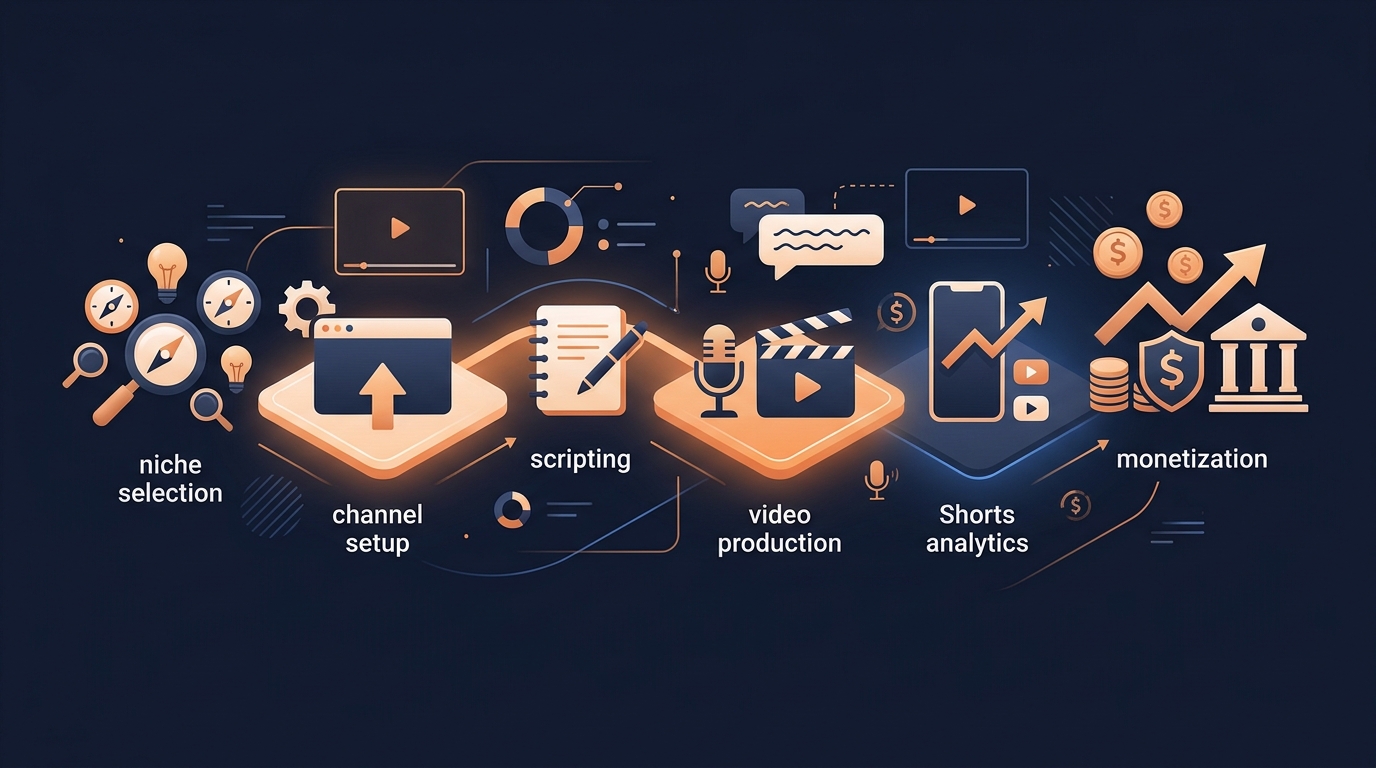
Building and monetising a faceless YouTube channel means selecting a focused audience and repeatable format, publishing original videos consistently, improving hooks and retention from performance data, and then earning through YouTube, sponsors, affiliates, products, or services. The system matters more than showing your face: every stage should make the next video easier to produce and improve.
Key takeaways:
- Choose a niche with a specific viewer problem or curiosity—not merely a broad topic you can post about.
- Build a repeatable production system before chasing volume; consistency depends on clear briefs, assets, scripts, and quality checks.
- For Shorts, the opening seconds and sustained viewing matter more than a polished intro or a long list of ideas.
- Treat monetisation as a stack: YouTube revenue can be one layer alongside offers that genuinely fit your audience.
- Use AI to speed up research and production, but retain editorial control, originality, rights awareness, and required disclosures.
How do I choose a faceless YouTube niche that can grow?
Start with the overlap of audience demand, your ability to make many useful videos, and a format you can sustain without being on camera. A viable niche is usually more specific than “finance,” “history,” or “motivation”: it identifies a type of viewer, a recurring question, and a recognisable promise. Test that promise by outlining 30–50 video angles before committing. If the ideas quickly become repetitive, narrow the audience or change the format.
Study channels for patterns, not templates to copy. Their pacing, packaging, topic selection, and content gaps can teach you what the audience expects while leaving room for a distinct point of view. Use faceless channel examples and the lessons behind them as research material, then explore faceless YouTube channel ideas that can work to widen your options. For a sharper decision framework, read about the best niches for faceless YouTube channels and how to find an AI YouTube niche in a saturated market. Choose one primary audience first; expansion is easier after viewers understand why they should return.
What do I need to set up before publishing my first videos?
Set up the channel around a clear promise, not just a name and logo. Define the audience, topic boundaries, format, posting cadence, visual style, and the action you want viewers to take after watching. Create simple templates for titles, briefs, scripts, descriptions, thumbnail or cover treatments where relevant, and a review checklist. These decisions reduce production friction and make your output more consistent.
Budget for the workflow you actually need rather than the most elaborate stack. Your starting costs can range from mostly time and basic tools to paid research, voice, editing, asset, and automation services. The useful question is whether a cost saves enough time or improves enough quality to support your plan. See how much it costs to start a faceless YouTube channel, a practical overview of AI video production costs for creators, and an assessment of whether AI video creation is cost-effective. When your foundation is ready, follow this fuller guide on starting a faceless YouTube channel to turn the plan into a launch sequence.
How should I build a repeatable faceless video production workflow?
A dependable workflow moves in one direction: topic research, angle, brief, outline, script, narration, visual plan, edit, captions, review, publish, and analysis. Keep a library of approved visual sources, music choices, brand elements, prompts, and script structures so every upload does not begin from zero. Storyboarding is particularly useful because it reveals whether each spoken claim has a visual counterpart before editing becomes expensive.
Decide where automation helps and where human judgment must stay in charge. Tools should support your intended format, give you control over the result, and fit your licensing and export requirements—not simply generate footage quickly. Compare options with this guide to what to look for in an AI video tool and this overview of AI video generators for faceless videos. Then learn how to get started with AI storyboarding so scenes serve the narrative rather than becoming interchangeable filler. A repeatable workflow protects quality while making it realistic to publish regularly.
How do I make faceless videos people will watch to the end?
Start with one precise idea per video. The hook should create an immediate question, tension, surprise, or promised payoff; the following lines must prove that the video will deliver it. Avoid long greetings, context viewers do not need yet, and visuals that merely decorate the narration. Instead, use a clear sequence: hook, setup, escalating information or story, payoff, and a natural next action.
Narration and visuals should work together. A credible, well-paced voice makes information easier to follow, while captions and scene changes reinforce the key point. Learn the practical choices behind AI voiceover for YouTube videos, then use this beginner’s guide to creating YouTube Shorts for the production fundamentals. Story-led formats can be especially effective without a presenter when the stakes and progression are clear; see how to make engaging faceless story videos. For alternate hook structures that work across short-form platforms, adapt these TikTok video hook formulas to your audience rather than forcing a generic trend.
How do I improve retention and engagement on YouTube Shorts?
Retention improves when each moment earns the next. Review where viewers leave, then diagnose the cause: an unclear opening, slow explanation, repeated information, weak visual change, or a payoff that arrives too late. Fix one issue per iteration so you can tell what changed performance. The goal is not constant chaos; it is clear momentum and enough variation to prevent attention from drifting.
Begin with the first-two-seconds hook principle, because viewers decide quickly whether a Short is worth their attention. Add intentional changes in framing, pacing, graphics, sound, question, or story direction with pattern breaks for short-form videos. For a broader editing and scripting approach, use these YouTube Shorts retention strategies, then interpret your results against YouTube Shorts retention rate benchmarks without treating any benchmark as a substitute for your own audience data. Finally, explore ways to use AI for more YouTube engagement, such as generating variations to test while keeping the final editorial decision yours.
How do I publish AI-assisted videos responsibly?
AI assistance does not remove the need for original editorial judgment, accurate claims, rights-cleared assets, and transparent practices. Before publishing, check the script for factual errors, ensure you have permission or appropriate licences for visuals and music, and make sure synthetic or altered material is not presented in a misleading way. Keep source notes and asset records, especially for videos involving realistic people, events, or sensitive topics.
Disclosure requirements can depend on the platform, the nature of the alteration, and whether viewers could reasonably be deceived. Start with whether AI-generated videos need disclosure, then read the platform-specific guidance on labelling AI videos on YouTube and staying compliant. Because platform rules and product features can change, also review the explanation of disclosing AI content on YouTube Shorts before building your publishing checklist. Compliance is not just a box to tick: clear labelling and responsible creative choices help preserve the trust that makes a channel commercially valuable.
How do I grow when the Shorts algorithm changes?
Treat distribution as a testing system, not a mystery to outsmart. YouTube shows a video to potential viewers and uses their response—including whether they choose to watch, continue watching, and engage—to inform further distribution. That means growth comes from repeated experiments with topics, openings, pacing, and packaging, followed by disciplined analysis of what changes audience response.
Understand the fundamentals through this breakdown of how the YouTube Shorts algorithm works, then go deeper into the distribution stages of the YouTube Shorts algorithm. Avoid rebuilding your whole channel after one low-performing upload or a rumoured update. Instead, compare groups of videos, identify whether the problem is topic appeal or retention, and make limited, documented changes. This guide to adjusting a Shorts strategy after algorithm changes can help you respond without abandoning what your audience already values. Build an audience relationship through useful, recognisable content; that is more durable than chasing temporary signals.
How do I monetise a faceless YouTube channel?
Monetisation works best after you have a defined audience and a clear reason they trust your content. YouTube revenue may be part of the model, but it should not be the only plan. Consider a mix of advertising eligibility, affiliate recommendations, sponsorships, digital products, services, memberships, licensing, or lead generation—provided each offer is relevant and disclosed appropriately. Choose revenue streams that enhance the viewer experience instead of interrupting it.
First, understand the routes and requirements in this YouTube Shorts monetisation guide and the details of monetising through the YouTube Partner Program in 2026. Music can affect how Shorts revenue is calculated, so read YouTube Shorts revenue sharing and music licensing before assuming every track has the same economics. Once you are eligible, use these methods to maximize YouTube Shorts revenue, while building a longer-term model with this guide to passive income from a faceless YouTube channel. Sustainable earnings come from a useful audience and repeatable offers, not a single viral upload.
Ready to streamline your short-form production?
One way to turn a repeatable workflow into finished videos is GoFaceless. It turns a topic, brief, or reference into a short-form video with an AI script, voiceover, visuals, captions, and music, while providing preview and export controls. It supports TikTok, Instagram Reels, and YouTube Shorts in vertical and 16:9 formats. Create your GoFaceless account to try a single-pass workflow instead of stitching separate script, voice, and editing tools together.
Keep reading

Kuinka aloittaa kasvoton YouTube-kanava vuonna 2026
Aloita kasvoton YouTube-kanava selkeällä yleisöluvalla, alkuperäisellä toimitusprosessilla, Shortsien testaamisella, pitkillä videoilla ja sääntöjen mukaisten tekoälyn käytöllä.

Pitäisikö sinun käyttää YouTube Shorts -palvelua anonyymiin sisältöön?
Opi, milloin YouTube Shorts on järkevä valinta anonyymille sisällölle, mitä RPM:ää odottaa ja miten valita Shorts-ensimmäinen, pitkä formaatti tai hybridi.

Kuinka tehdä kiehtovia kasvottomia tarinavideoita
Opettele, kuinka voit tehdä alkuperäisiä kasvottomia tarinavideoita, joissa on vahvempia koukkuja, pikkukuva, latausprosesseja, tekoälypaljastuksia ja YouTube-yhteensopivaa tuotantoa.